
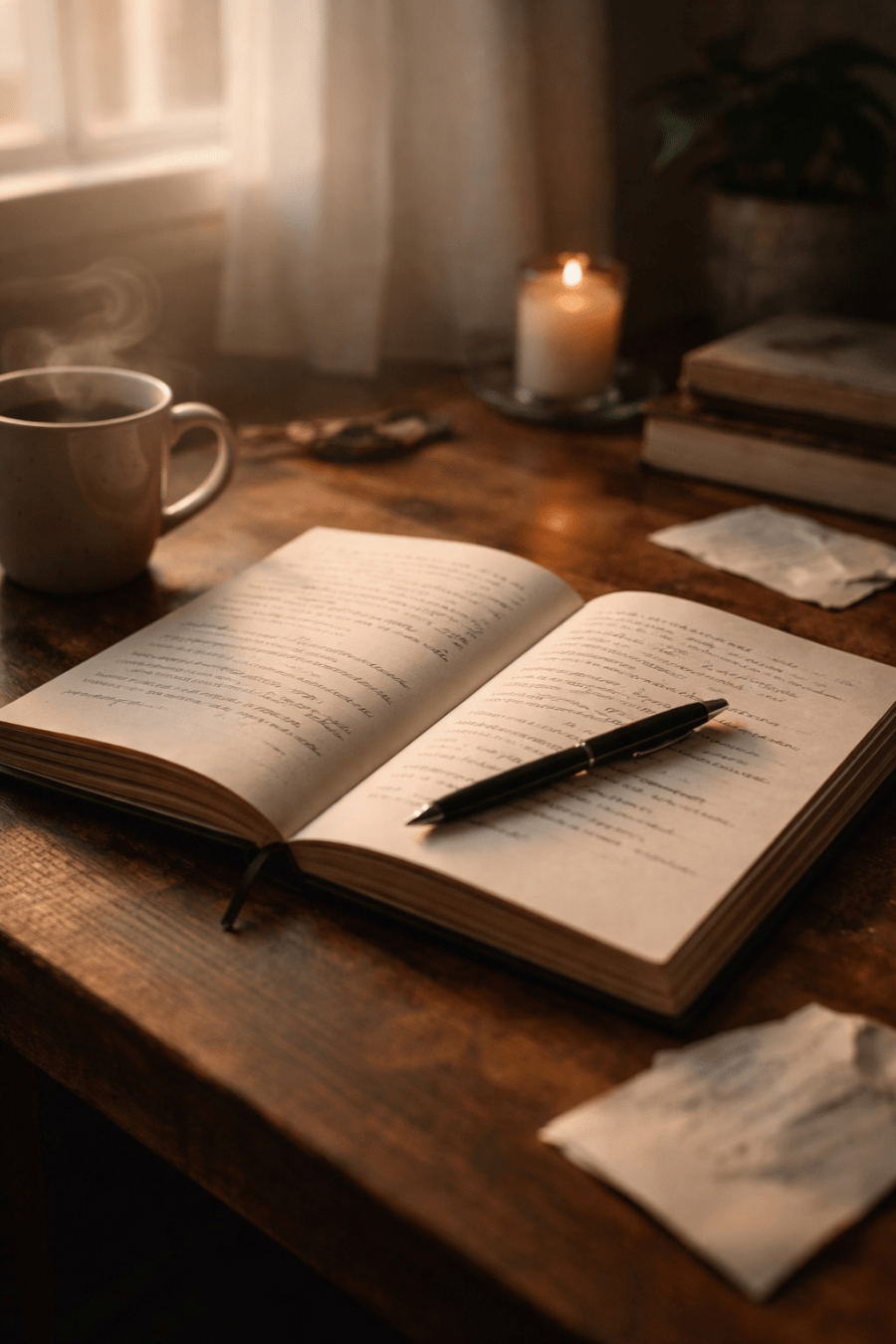
I find the diary on a morning that already feels wrong.
Not wrong in a dramatic way. Wrong in the way rooms feel after an argument—everything technically in place, but the air heavier than it should be. My body is moving before my thoughts catch up. I’m brushing my teeth when I realize I don’t remember waking up.
The mirror doesn’t help. My reflection looks tired in a way sleep doesn’t fix. There’s a faint line of ink along the side of my thumb, nearly washed away. I don’t own a pen that leaks like that.
The diary is on my desk.
It’s open, like it expects me.
I don’t remember putting it there. I don’t remember owning it. But the moment I touch the cover, something in my chest tightens with recognition. The wear along the spine matches the way I worry at things when I’m thinking. The corners are bent inward, protective. Familiar.
Inside, the handwriting is mine.
I don’t need to compare it to anything. My body knows. The slant, the spacing, the way some letters almost collapse into each other when I’m rushing. I’ve written like this my whole life.
I just didn’t write this.
The first entry isn’t dated. It doesn’t need to be.
You didn’t sleep.
My throat closes.
I flip the page, then another. Each entry reads like someone taking notes on a version of me I don’t fully inhabit. It describes my routines with an intimacy that feels invasive—how long I stare at the ceiling before getting up, the way my hands shake when I think no one is watching, the moments when my thoughts slow until they feel underwater.
Things I’ve never said out loud.
Things I barely admit to myself.
Some days are missing. Not torn out. Just… absent. Blank pages waiting for something that never came. My chest aches when I realize those are the days I remember clearly.
The days I was myself.
I sit on the floor and keep reading until my legs go numb.
One entry is messier than the rest. The ink presses deeper into the page.
You cried today. You didn’t notice when it started.
I don’t remember crying.
You kept apologizing. I took over before you disappeared completely.
My vision blurs. I press the heel of my hand into my eye like I can force the feeling back down, like that’s ever worked.
I want to be angry. I want to feel violated, stolen from. But all I feel is tired. Bone-deep, soul-level tired. The kind that makes fear feel like too much effort.
That night, I lie in bed and stare at the ceiling.
I don’t sleep.
I blink—and it’s morning.
Sunlight spills across the room in a way that tells me time has passed without my consent. My phone is fully charged. There are messages sent in my voice, with my humor, my cadence—but I don’t remember typing any of them.
My hands ache, like I’ve been gripping something for hours.
The diary is open beside me.
A new entry waits.
You fought me longer this time.
My breath catches.
I know you don’t like losing time. I don’t like watching you hurt.
Tears come before I can stop them. Quiet ones. The kind that feel practiced, efficient.
I sit at the desk and turn to a blank page. My pen shakes so badly I have to steady it with my other hand.
“Why can’t I remember?” I write.
The answer is already there on the next page.
Because you survive by forgetting.
I press my forehead to the paper and breathe in the smell of ink and old pages. It smells like grounding. Like proof.
I hold the things you can’t, the diary continues. I stay when you leave.
Something inside me softens. Not relief—something closer to grief. For all the versions of myself that have been keeping me afloat while I drifted.
“I’m scared,” I write.
The response comes later. Slower. Careful.
I know.
But you’re not broken.
You just learned how to split the weight.
When I close the diary this time, it’s not in panic.
It’s in trust.
And for the first time in days—maybe longer—I let myself sleep.


This hit quietly and then all at once. The way the unease creeps in—not with shock, but with small wrongnesses like lost time, ink on a thumb, a room that feels heavier—felt incredibly real. I love how the horror here isn’t loud or external; it’s intimate, internal, and deeply human.
The diary is such a powerful device. The fact that the handwriting is unmistakably yours, that the body recognizes it before the mind does, makes the whole thing feel grounded and unsettling at the same time. And the missing days being the ones remembered clearly? That line stopped me. It reframes memory not as proof of wholeness, but as evidence of absence.
What really stayed with me, though, is the tenderness between the two voices. This isn’t a story about something monstrous taking control—it’s about something protective stepping in. Lines like *“I don’t like watching you hurt”* and *“I hold the things you can’t”* feel less like possession and more like survival turned inward. There’s grief there, but also care.
The ending especially landed. Closing the diary “in trust” instead of panic feels earned, and the idea that splitting wasn’t breaking but learning how to carry the weight is quietly devastating in the best way. It left me feeling sad, soothed, and seen all at once. This reads like an acknowledgment of survival strategies we don’t always have language for—and that makes it linger.
LikeLiked by 1 person
Thank you so much for your thoughtful comment. Reading how you noticed the quiet unease, the missing days, and the way the two voices interact really resonates with what I was hoping to capture. I love that you picked up on the tenderness in the diary—it’s exactly the kind of subtle survival I wanted to explore. Your words make me feel seen as a writer, and I’m so glad the story lingered with you in that way.
LikeLiked by 1 person