

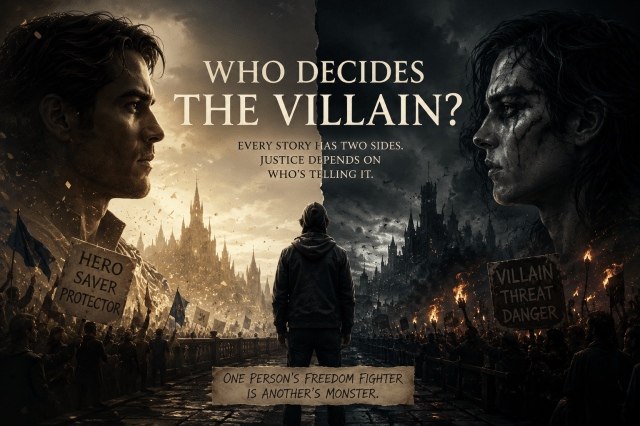
What villain actually had a good point?
The more I think about it, the harder this question becomes.
Not because I can’t think of a villain with a good point, but because it makes me wonder who decides they’re the villain in the first place.
Is someone truly a villain because their beliefs are wrong? Or because the hero opposes them? What actually defines a hero? What determines justice?
Society tells us what’s right and what’s wrong, but history has shown that society isn’t always right. Many fictional villains are products of a system that failed them long before they ever became an antagonist. They’re ignored, abused, manipulated, betrayed, or cast aside until they eventually break. By the time the story begins, we only see the monster—not the countless moments that created them.
None of that excuses the harm they cause. Innocent people should never become collateral damage. But understanding why someone became who they are is different from justifying what they did.
Maybe that’s why so many villains resonate with people. They often start with a legitimate grievance or a painful truth that no one wanted to acknowledge. It’s their methods—not always their message—that turn them into the antagonist.
Perhaps the best stories aren’t about heroes defeating villains.
Perhaps they’re about what happens when a broken world creates someone it refuses to understand, and then labels them the enemy.
 The Cozy Nook | Stories · Food ·Gaming·Magic
I think about Magneto, of course, in the context of this conversation. I think about Ozymandias and Dr. Manhattan from The Watchmen. I think about a really well-written book called _Soon, I will be Invincible_ by Austin Grossman, written from the viewpoint of the “villain”. I think about mythological villains and how I prefer less black-and-white “villains” like Loki, the Trickster, Set, etc. I don’t really have an answer to this question other than humans like to have another human or another set of humans that they can feel superior towards, I think, and when that other human or set of humans does something different, then of course yes, they’re the villains.
LikeLiked by 1 person
I love the examples you chose because none of them fit neatly into the role of ‘evil for the sake of being evil.’ They all challenge the idea that morality is black and white. I also find your last point interesting—that people often need someone to define themselves against. Maybe that’s part of why stories with morally gray characters feel so compelling. They force us to question whether we’re judging actions, motives, or simply whose perspective we’re following. Thanks for giving me even more to think about.
LikeLiked by 1 person