
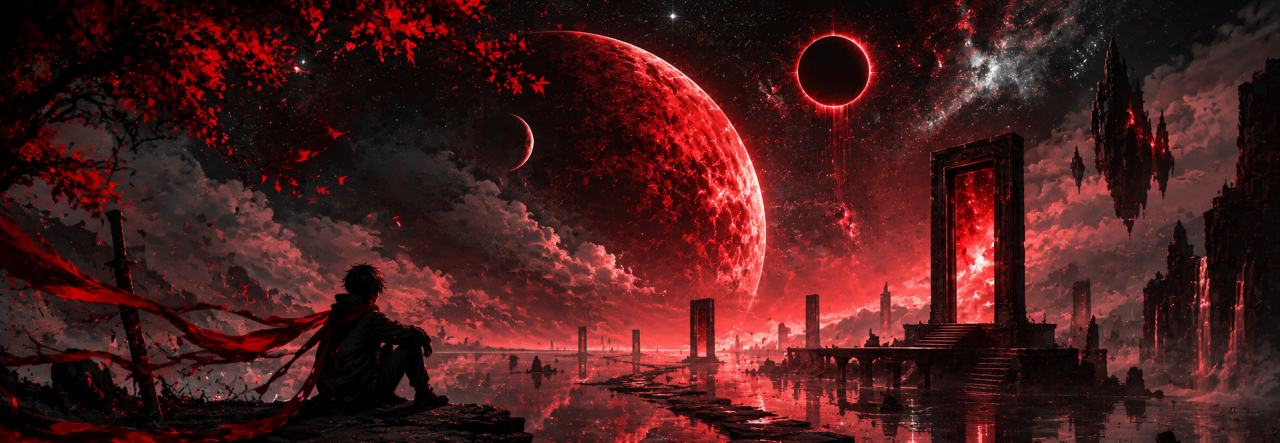
The Spaces Between the Stars: Exploring the Liminality of the Universe
There’s something unsettling about space.
Not just because it’s endless, but because so much of it exists in-between.
Between stars.
Between galaxies.
Between what we understand and what we never will.
When most people think about the universe, they think about the visible things — planets, constellations, suns burning across impossible distances. But lately, I’ve found myself more fascinated by the spaces that aren’t easily seen. The silence between celestial bodies. The hidden structures holding everything together. The places where reality itself seems unstable.
Maybe that’s because liminal spaces have always felt strangely human to me.
We spend so much of our lives in transition without realizing it. Between versions of ourselves. Between grief and healing. Between endings and beginnings. Existing in spaces where nothing feels fully solid anymore.
And honestly?
The universe feels the same way.
The Darkness Between Everything
One of the strangest things about the cosmos is that most of it is invisible.
Scientists believe dark matter makes up a massive portion of the universe, yet nobody can directly see it. We only know it exists because of the way galaxies move — as if something unseen is holding them together from the shadows.
I think there’s something deeply haunting about that.
An invisible force connecting everything across unimaginable distances.
It reminds me of memory in a way. Or emotion. Or trauma. The things we carry that nobody else can fully see, yet they still shape how we move through the world. They pull at us quietly. Alter our gravity. Change our direction without anyone realizing it.
Sometimes the most powerful things are the things hidden underneath the surface.
Black Holes and the Fear of Becoming Unknown
Black holes feel like the ultimate liminal space.
They exist at the edge of understanding — places where time bends, light disappears, and the laws of physics begin collapsing into something we can barely comprehend. A boundary where crossing too far means you may never return the same.
There’s something terrifying about that, but also strangely familiar.
I think a lot of people experience emotional black holes in their lives. Periods where they feel consumed by grief, depression, isolation, identity loss, or fear. Moments where the person they used to be begins collapsing inward.
And yet transformation often happens there too.
Not in comfort.
Not in certainty.
But inside collapse.
Stars themselves die violently before creating something new. Entire galaxies reshape through destruction. The universe does not fear becoming different — even when that change looks catastrophic from the outside.
Humans do.
Wormholes and the Desire to Escape
If black holes represent collapse, wormholes feel like longing.
The idea that somewhere in the fabric of reality there could be hidden passageways connecting distant places almost feels mythological. A doorway folded into existence itself. A shortcut through impossible distance.
I think people spend their entire lives searching for wormholes.
Not literal ones, obviously — but emotional ones.
Ways to escape pain faster.
Ways to skip grief.
Ways to outrun loneliness.
Ways to become someone else overnight.
But maybe transformation was never meant to be instantaneous.
Maybe the journey through uncertainty is what changes us in the first place.
Liminality is uncomfortable because it forces us to exist without resolution. No clear destination. No guarantee of meaning. Just movement through the unknown.
The universe seems filled with that uncertainty.
And somehow, despite everything, it continues expanding anyway.
Existing Between Worlds
Sometimes I wonder if humans are naturally drawn to cosmic horror and space because it reflects something internal we struggle to explain.
We are conscious beings trapped on a small planet floating through an endless dark, constantly searching for meaning while knowing how temporary everything is. That alone feels liminal.
We exist between birth and death.
Between memory and oblivion.
Between reality and perception.
Even sleep itself feels like crossing dimensions sometimes — drifting into dream worlds where identity fractures, time distorts, and impossible things feel real until morning pulls us back.
Maybe that’s why the universe feels so personal to people despite being incomprehensibly large.
Because deep down, we recognize ourselves in it.
Not in the stars themselves —
but in the spaces between them.
The places where things are still forming.
Still changing.
Still becoming something unknown.
 The Cozy Nook | Stories · Food ·Gaming·Magic