
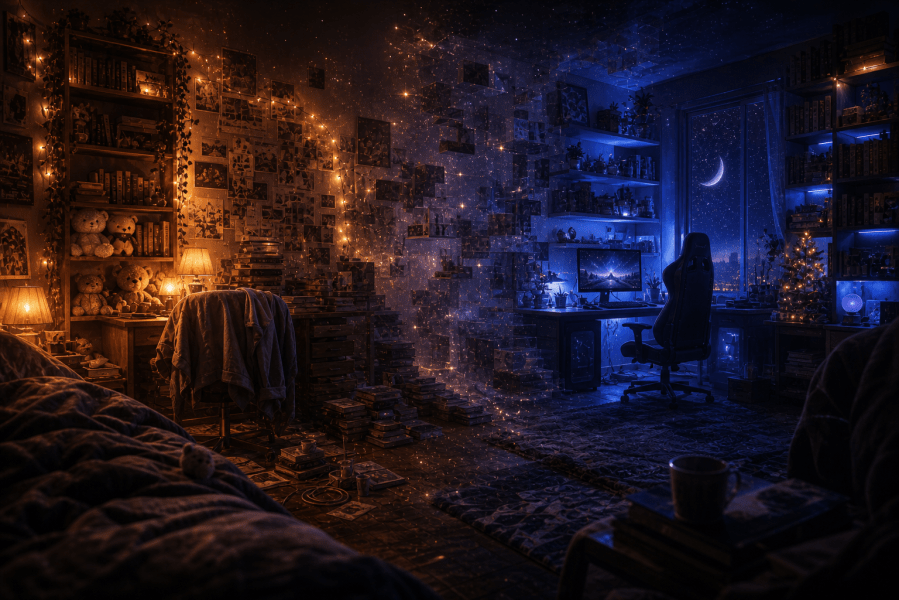
People assume disorder means absence.
Absence of discipline.
Absence of care.
Absence of structure.
But my room has never been empty of structure.
Only structured differently.
To someone else, it probably looks chaotic. Clothes draped over chairs. Books stacked in uneven towers. Stuffed animals occupying corners like silent guardians. Half-finished notebooks. Cords crossing through everything like veins. Small piles that seem random unless you’re the one living inside them.
But I know where things are.
Not in the way a filing cabinet knows.
Not alphabetically.
Not neatly.
But instinctively.
My room exists the same way memory does.
Associative. Emotional. Spatial.
I reach for things without thinking because somewhere in my mind, I mapped them long ago. A shirt tossed onto a specific chair. A notebook hidden beneath another book. A charger placed in a pile that would confuse someone else instantly makes sense to me. The room becomes less of a room and more of an extension of thought itself.
And strangely, when everything becomes too organized, I lose that map.
The room stops feeling breathable.
Stops feeling lived in.
It starts feeling staged. Like a museum version of myself where every object has been positioned for appearance instead of comfort.
That’s the part people don’t understand: chaos and neglect are not always the same thing.
Because there are parts of me that need precision.
My bookshelf.
My desk.
My gaming setup.
Holiday decorations carefully arranged with almost ritual-like attention.
Move one object, and I notice immediately.
Those spaces are different. They are controlled points inside the storm. Small anchors in the middle of everything else. Places where the world feels aligned for a moment. I know exactly how I want them to look, exactly where things belong, exactly how they should feel.
Maybe that contradiction sounds strange.
How can someone live in chaos while also needing certain things untouched?
But the truth is, people often misunderstand organization. They think there is only one version of it — clean lines, empty surfaces, perfect symmetry. As if peace can only exist in minimalism.
For some people, maybe it can.
But for me, spaces that are too clean feel almost claustrophobic. Not physically, but mentally. Like the room has been stripped of evidence that a person actually exists there. Nothing mid-thought. Nothing in progress. Nothing unfolding.
Just stillness. Sterility. Completion.
And maybe that’s why I keep things around me the way I do.
Not because I don’t care.
Not because I’m lazy.
Not because I enjoy disorder for the sake of disorder.
But because my mind organizes space differently.
My chaos has patterns.
It has memory.
It has emotional geography.
Maybe every person builds their own internal map of comfort. Some people survive through symmetry. Others through visible existence. Some need emptiness to think clearly. Others need to see life around them to feel grounded.
Maybe my room only looks chaotic because no one else can read the map.
And this isn’t about other people’s ways of experiencing organization or control. I know for some people—like my fiancé—structure isn’t just preference, it’s something much deeper and more important tied to how their mind works. This is just about my own internal experience of space, not a comparison or judgment of anyone else’s needs.
There’s also something I’ve started to notice about change.
I think once we’re living together, I’ll be able to handle structure differently. Not because I’ll be pressured into it, and not because someone will be changing me — but because the environment itself will shift.
Right now, my room is my entire world. It holds everything: rest, work, thinking, escape, creation. So it naturally becomes a map I rely on.
But shared space changes that kind of weight.
It creates balance. Presence. Another person’s rhythm existing alongside mine.
And I think that might quiet the need to map everything so tightly, not because the map disappears, but because it won’t have to hold everything anymore.
Some of it will be shared. Some of it will be lighter. Some of it will simply exist differently.
Not erased. Not replaced.
Just softened into something that doesn’t need to carry everything alone.
And maybe that’s what growth actually looks like.
Not becoming less of myself.
But becoming less alone inside my own structure.

