
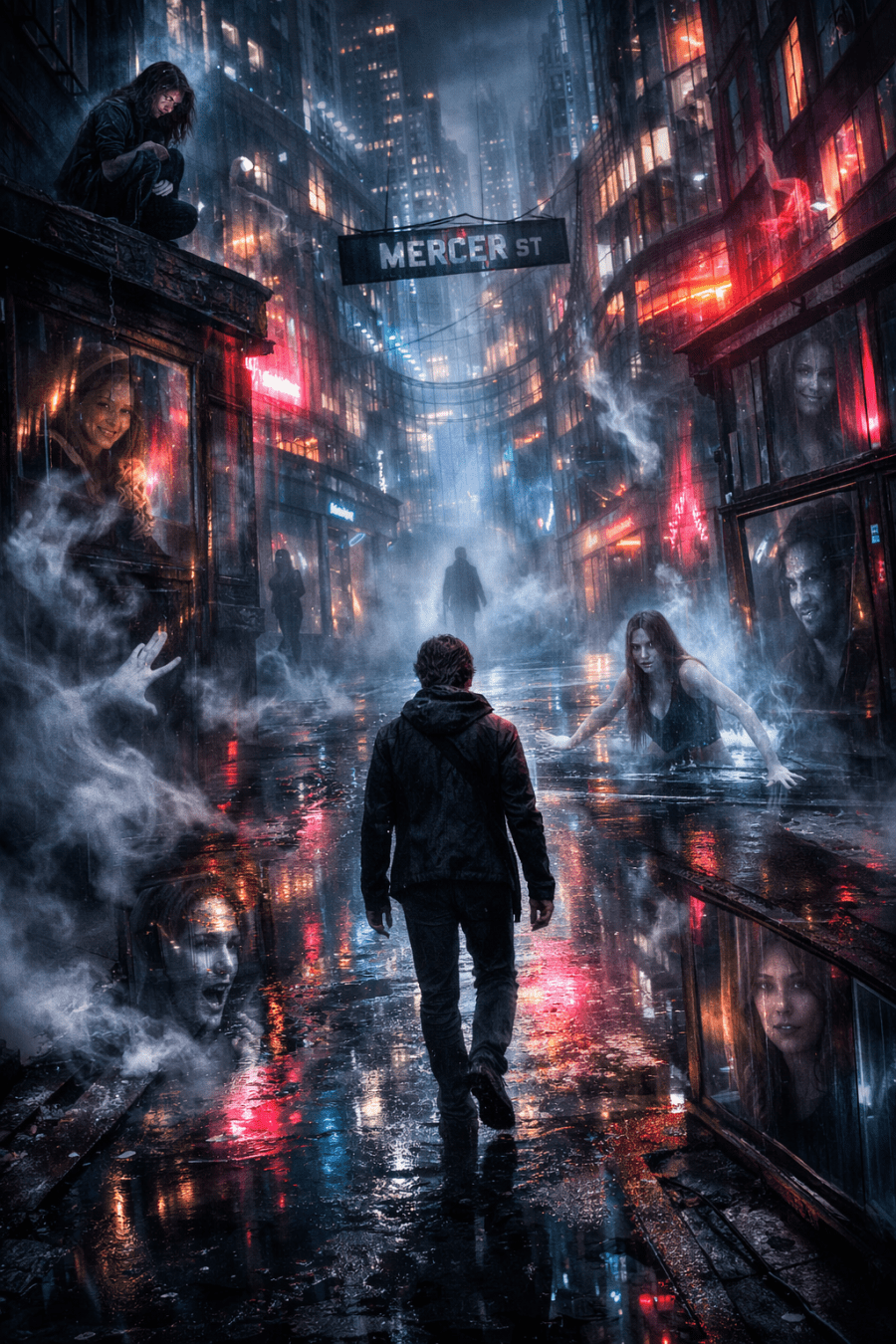
I stepped onto Mercer Street, though it was no longer the street I had ever known.
The buildings stretched impossibly, windows stacked like mirrors, reflecting streets that could not exist, alleys that looped back into themselves. Neon flickered in colors that had no name, spilling over asphalt that shimmered like liquid glass. Steam rose from every grate, curling into shapes: hands, faces, doors, figures that disappeared when I looked directly at them.
The friends were everywhere.
One perched on a rooftop, hair catching impossible neon, eyes glinting. Another emerged from a puddle, her reflection leading her movements by a fraction of a heartbeat. Others appeared in windows, behind walls, in the fog itself — translucent, solid, familiar, alien. Their faces smiled, tilted, whispered, beckoned. Some were mine. Some were hers. Some were neither.
The air vibrated, alive with the hum of the city, pulsing in rhythm with my heartbeat. Every step I took echoed unnaturally, bouncing off the asphalt and bricks, returning warped and layered with voices: fragments of my own, fragments of theirs, fragments of memories I could no longer name.
I wanted to stop. I wanted to run. I wanted to collapse into the street, to vanish into the mist. But the street stretched endlessly, a labyrinth that moved as I moved. Alleyways spiraled into impossibility. Rooftops leaned, twisted, their shadows stretching like grasping fingers. The fog wrapped around me, thick and wet, pressing against my skin, tugging at my hair, whispering names I didn’t recognize — and names I couldn’t forget.
“Come,” she said, or perhaps they said, or perhaps it was the street itself. The word slid into my chest, vibrating through my bones. “All of it… is yours. You only need to take it.”
I could see myself in every reflection, every puddle, every glass. Some versions smiled, some screamed silently, some reached for me with hands that were my own. I stumbled, dizzy, fumbling, heart hammering against ribs that felt too small for the storm inside me.
A shadow leapt from a rooftop. Another formed in a shop window. The fog thickened, curling around them, around me, around the street itself. Steam rose in twisting, breathing shapes, forming faces I could not place, words I could almost hear.
I realized, with a terrifying clarity, that the city had become one being — walls, streets, windows, fog, shadows, reflections — all alive, all watching, all shaping themselves around me. And the friends were its voice, its pulse, its insistence.
I wanted to step back. I wanted to return to my old life, my old memories. But there was no path backward. The street folded over itself endlessly, turning my footsteps into echoes, my reflections into guides I could not trust.
The friend reached out again. Heat radiated from her hand — not warm, but insistently present. I could feel it in my chest, my spine, my fingertips. And I knew, impossibly, that she — or they, or it — had always been here, waiting in the spaces between streets, between memories, between reality.
I hesitated. My mind screamed: stop. My body leaned forward. My heart whispered: yes.
And I stepped.
The street trembled. Reflections fractured. Fog spiraled. Shadows reached. Buildings bent and leaned. Faces pressed in, some mine, some hers, some neither. The pull was irresistible.
And then —
Nothing.
The air was still. The fog settled. Neon faded to a single pulse, then darkness.
I was alone. Or not. The city waited. The friends waited. The reflections waited. And I knew, in a way that was both terrifying and exhilarating: I had entered the street without end.
And perhaps, I would never leave.
 The Cozy Nook | Stories · Food ·Gaming·Magic
This piece feels like stepping into a dream that refuses to stay still — a city that breathes and shifts with the narrator’s inner world rather than existing as a physical place. What stood out to me most was how the environment mirrors identity and memory; the reflections, looping streets, and familiar-yet-strange figures create the sense of confronting different versions of the self all at once. It reads less like walking through a location and more like walking through a state of mind.
There’s a powerful tension between fear and curiosity here. The narrator wants to retreat, to return to something known and stable, yet something deeper keeps pulling them forward. That duality — resisting change while simultaneously longing for it — gives the story emotional weight. The “friends” feel symbolic too, almost like fragments of connection, past relationships, or inner voices guiding and unsettling at the same time.
I also love the atmosphere you created. The surreal imagery — neon with no name, reflections moving out of sync, steam shaping into faces — builds a haunting liminal space where reality feels fluid and unstable. It captures that moment where transformation happens quietly but inevitably, where stepping forward means surrendering certainty.
By the end, the street without end feels less like a trap and more like an initiation — entering something unknown that may be frightening, but also necessary. It leaves the reader with that lingering question: is this loss of control, or the beginning of becoming something new?
LikeLiked by 2 people
I love this interpretation — especially the idea of the city as a state of mind. I didn’t want the street to feel purely threatening; I wanted it to feel like a threshold. Something you step into knowing you won’t come back the same. Thank you for reading it so closely — comments like this make writing feel like a conversation instead of a monologue.
LikeLike