
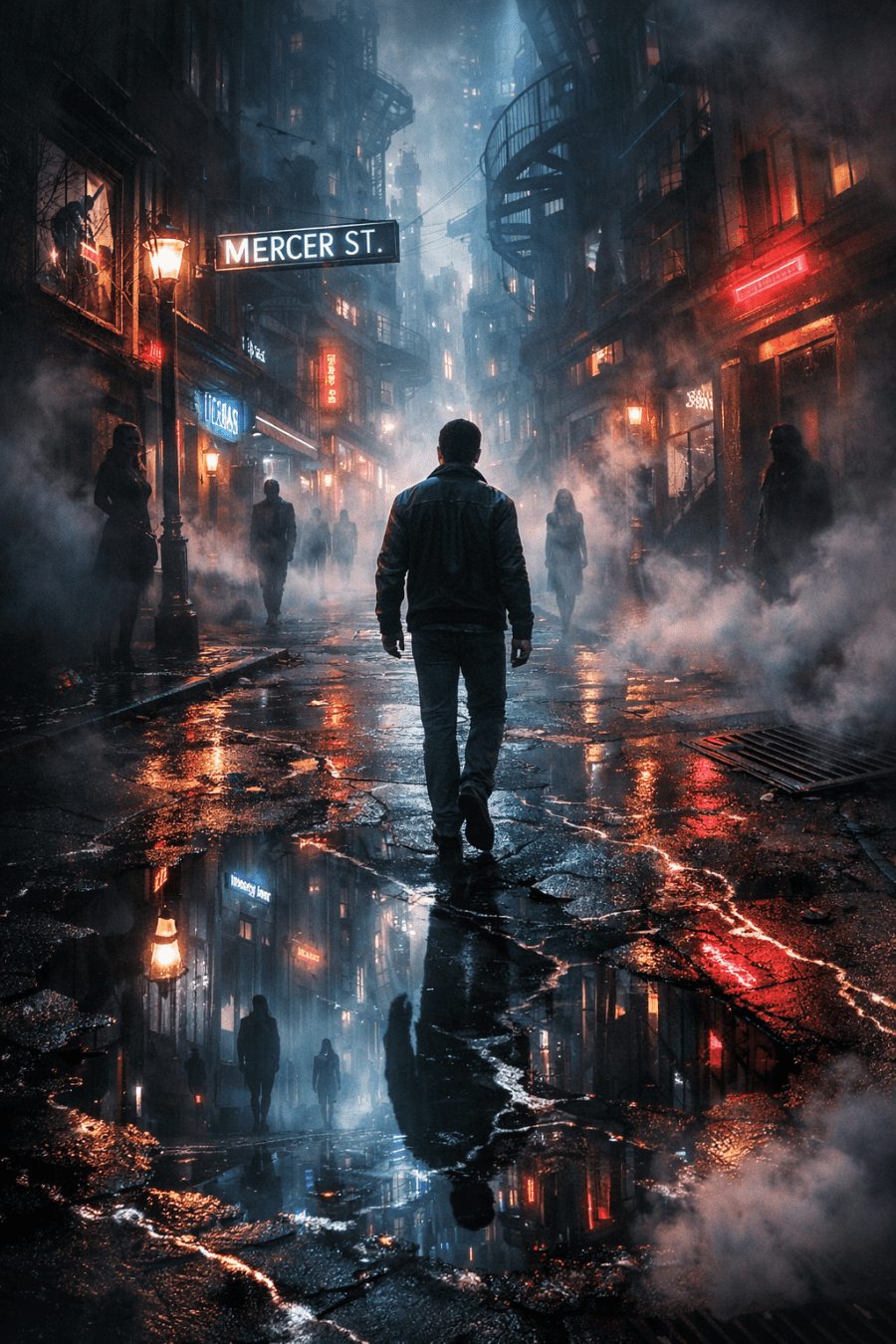
I woke on Mercer Street, though it wasn’t the Mercer Street I knew.
The asphalt was slick, reflective, and fractured — cracks running like veins, pulsing faintly under the neon light. Steam curled from every grate, thick and warm, carrying the scent of wet concrete, iron, coffee, and something… impossibly sweet, almost alive. The street smelled like memory, like a photograph left out too long. But the memory wasn’t mine. I couldn’t place it.
And then I noticed: I couldn’t remember.
Not fully. Names blurred at the edges of my mind. Faces I should have recognized — friends, family, strangers — shifted into shadows. Some were fragments of people I had known. Others were copies of myself, staring back from puddles, windows, mirrors.
The friends appeared, as if reading the gaps in my memory.
One stood leaning against a streetlamp, hair glinting in neon. Another emerged from the fog curling along the alleys, silent, waiting. They were everywhere and nowhere. Some smiled, some tilted their heads like predators sizing me up, some whispered words that dissolved before I could understand them.
The city itself had changed. Buildings stretched upward impossibly, windows flickered with faces that shouldn’t be there, alleys folded over themselves, staircases spiraled into the clouds. Reflections in puddles showed streets I had never walked, doors I had never opened, friends I had never met — or perhaps had, once, and had forgotten.
I reached for one reflection, and it shivered under my fingers. The puddle warped, drawing me in, and I stumbled back, heart hammering. My breath came in shallow, ragged gasps. I wanted clarity, memory, something solid to hold onto — but everything was slipping.
“You’re forgetting,” she said, the friend from the cafe, or the alley, or perhaps both. Her voice was soft but piercing, threading through the fog, brushing against my spine. “Every memory you cling to… it’s already gone. And I’ve always been here.”
I tried to speak. My name — my own name — caught in my throat. The city pressed close, fog curling into my hair, around my neck, brushing my skin with invisible fingers. Shadows leapt across the walls and rooftops, multiple versions of friends I had seen, never seen, imagined, remembered. Their eyes gleamed with recognition I could not reciprocate.
A window shattered in the street behind me, a thin spiderweb crack spreading like lightning. Faces pressed against the glass, mouths moving, whispering fragments of my past, memories I could no longer reach. One smiled — too familiar, too sharp — and I realized I could not tell if it had been me, or her, or some part of the city speaking.
I stumbled forward. The street narrowed, then widened impossibly. Steam from grates rose and condensed in shapes I couldn’t name: hands, faces, doors, letters that blinked and vanished. Reflections multiplied, overlaid, distorted. Every step I took echoed in the bricks and asphalt, bouncing back altered.
“You are mine to find,” she whispered again. And the words weren’t hers alone. They were hers, the city’s, the shadows’, my own voice. “You always come back. And you always forget.”
I stopped. My head spun. I could not recall the life I had walked away from, the people I had loved, the streets I had known. I only knew this: the city, the fog, the friends — they existed for me, and I existed for them.
A chill ran along my spine. Every nerve screamed both fear and longing. I wanted to turn back, wanted to leave Mercer Street behind. But the streets had already shifted behind me; alleys had twisted closed, buildings bent impossibly. There was no path backward.
And I realized with dizzying clarity:
I was walking forward.
Because the city would not release me.
Because the friends would not let me go.
Because memory itself had abandoned me, leaving only the pull of what was, what had been, and what could never exist outside this moment.
And I understood, finally, that I had no choice — only to follow.

