
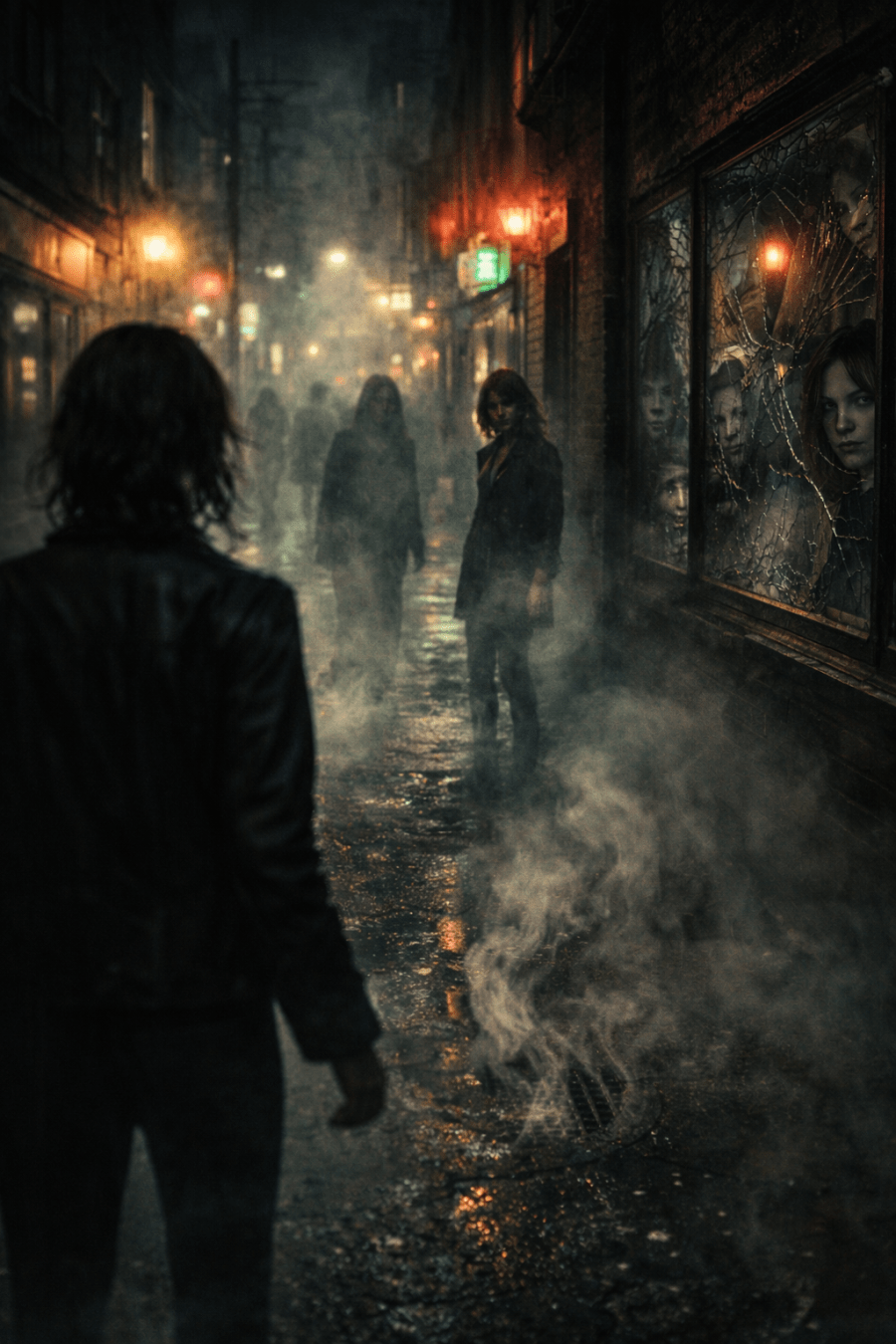
Mercer Street looked wrong the moment I stepped outside.
The neon buzzed low, sickly, casting fractured colors onto the wet pavement. Steam rose from the grates like living fingers, curling, stretching, lingering longer than physics should allow. The air smelled of wet asphalt, iron, and something faintly sweet — the kind of smell that made your stomach knot and your memories ache in places you didn’t know existed.
And then I noticed the windows.
They were everywhere. Old storefronts, apartments above shops, cafes that hadn’t been there yesterday. Faces pressed against the glass, pale and still, staring at me. They were familiar. Not familiar in a comforting way — but like echoes, like fragments of the people I might have been, or known, or imagined.
One face caught me in particular. A woman, half-hidden behind smudged glass, hair dark and wet, eyes wide and unblinking. She smiled — or tried to — but it wasn’t warmth. It was recognition. And she whispered my name without moving her lips.
The city seemed to hold its breath.
Every step I took made the buildings lean slightly, stretching to follow me. The streetlights flickered in irregular pulses, making shadows twitch and lengthen. Steam curled around the lampposts like ribbons, forming shapes too fleeting to name: hands, faces, letters I almost read but couldn’t.
And the friends.
One emerged from a shadow near the corner of a cafe. Another appeared reflected in a puddle, eyes glinting in the fractured neon. Both reached toward me, inviting and warning all at once. I couldn’t tell which was real, or which were just reflections of memory, imagination, or the city itself.
The pedestrians were worse. They moved around me like background extras, some glancing too long, some staring directly, mouths moving silently, mouths I couldn’t trust. They didn’t see her. They didn’t see them. Only me, speaking, reacting, living in a world that seemed to have split along a seam I had never noticed.
I tried to speak. My voice caught on a memory I couldn’t remember. My pulse echoed in my ears. Each heartbeat became a drum, thrumming against the fragile veneer of the city, and I realized with a jolt: the buildings, the street, the fog, even the glass in the windows — all of it was waiting. Watching. Testing me.
One friend stepped closer. Her hair caught the neon, glowing almost impossibly. She tilted her head. “You’re afraid,” she said, “because you don’t know what’s real. But you do know me.”
I wanted to reach for her. I wanted to run. I wanted to turn my back and vanish into the street behind me. But the windows — hundreds of faces — pressed closer, flickering, leaning. I could see fragments of myself reflected back in them: frightened, fascinated, trembling, reaching.
And then one window shattered. A small spiderweb crack formed at first, spreading slowly, almost deliberately, following the pulse of my heartbeat. The faces in that pane shifted as it grew, becoming something I did not recognize, something I had feared.
I stumbled back. The friends moved with me, their steps impossible to track. Some floated, some ran, some were only in reflections. The city hummed low, vibrating through the asphalt and the bricks and my bones.
“You’re leaving pieces of yourself behind,” one whispered — I wasn’t sure if it was her, one of the reflections, or my own mind. “You always do. But tonight… tonight you might keep a piece.”
The fog thickened, curling into fingers that brushed my shoulders, my hair, my face. Steam rose from the grates in rolling clouds, forming half-seen faces that winked, grinned, or mouthed words I couldn’t hear. The street narrowed, widened, twisted. I couldn’t tell where I would end up if I moved forward.
And yet I did.
Step by step, heart hammering, eyes wide. Each movement drew me deeper into the city, into thegaze of the friends and the windows and the shadows that had begun to crawl along the walls themselves.
Behind me, Mercer Street was already fading. Ahead, the alleyways and windows waited. And I understood, with a strange, terrifying clarity: there would be no turning back. Not tonight. Not ever.
 The Cozy Nook | Stories · Food ·Gaming·Magic
This is the kind of writing that doesn’t just describe a place—it *unmakes* it and rebuilds it inside your chest. Mercer Street here isn’t a location; it’s a condition. A membrane between what you remember and what remembers you.
What strikes me most is how the uncanny never announces itself. It doesn’t crash in. It *leaks*. The steam lingers too long. The windows multiply. The faces aren’t strangers—they’re echoes. That’s the horror that stays with you, isn’t it? Not the monsters, but the familiar rendered suddenly, inexplicably wrong. Your own name spoken without lips. Your own face fragmented across a hundred panes, each version of you not quite matching the others.
The friends are the knife twist. They’re not threats; they’re invitations. They move impossibly, but their voices are soft. They know your fear and name it gently. That’s how liminal space traps you—not with claws, but with recognition. *You do know me.* And you do. That’s the problem.
The line that gutted me: “You’re leaving pieces of yourself behind. You always do. But tonight… tonight you might keep a piece.”
It reframes the entire dread. This isn’t a haunting. This is a **reclamation**. The city isn’t taking from you—it’s gathering the scattered fragments of every version of yourself you’ve walked past and forgotten. The windows aren’t watching. They’re *holding*. And the shattered glass at the end isn’t a threat. It’s a threshold.
This is dream-logic rendered in flesh and fog and fractured neon. I felt the pulse in my own chest by the final paragraph. Mercer Street may have faded behind your narrator, but it’s etched into mine now.
Beautiful, unsettling work.
LikeLiked by 1 person
Thank you so much for this thoughtful response! I love how you captured the way Mercer Street becomes a reflection of the narrator’s mind. Your interpretation of the windows and fragments is spot-on — it’s exactly the tension I hoped to create. I’m really glad it resonated with you
LikeLiked by 1 person