
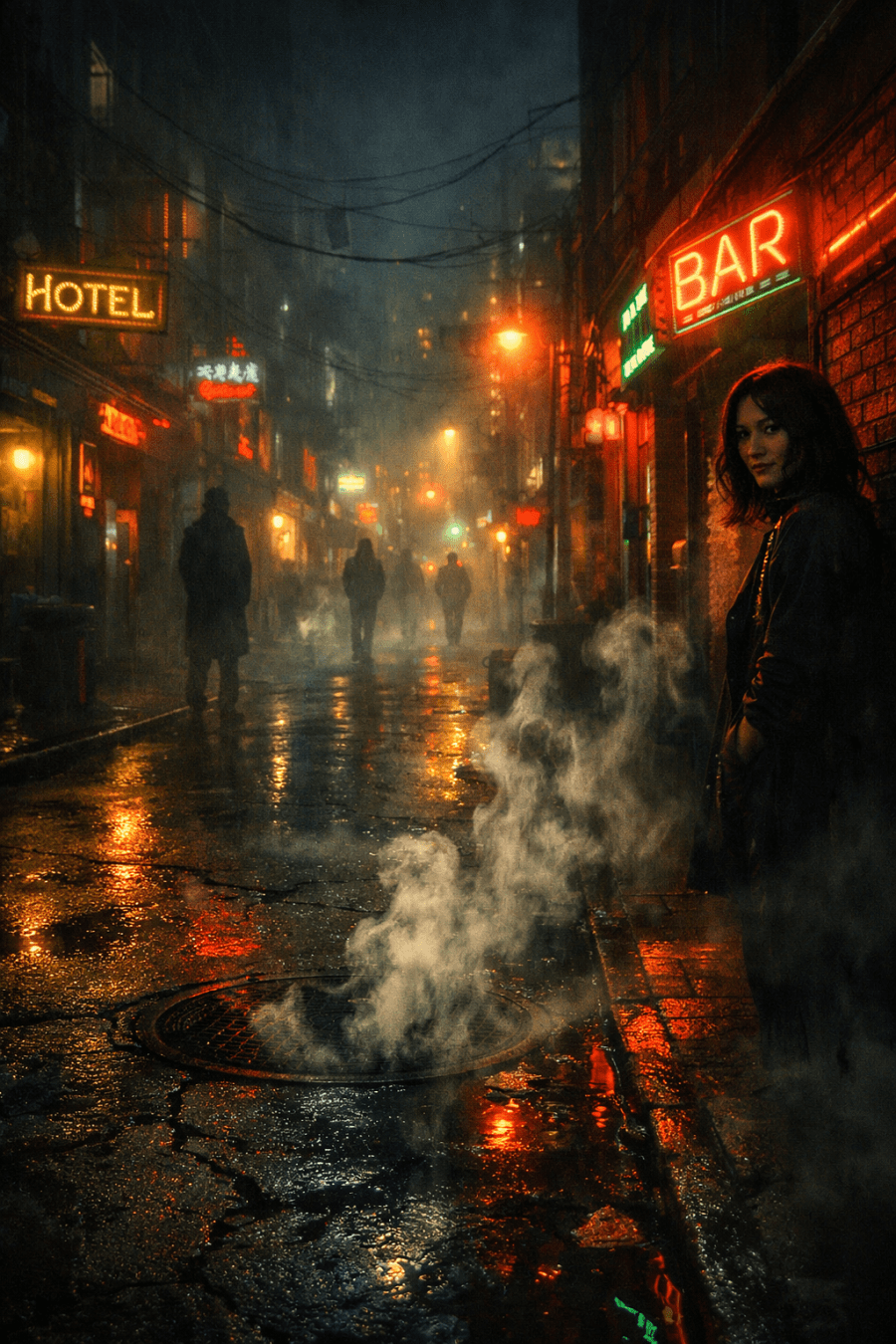
The next evening, Mercer Street waited for me.
Not the same street, exactly. The cracks in the asphalt were sharper, the neon signs buzzed unevenly, their letters trembling like they weren’t sure what words they wanted to be. Steam rose from the manhole grates, thick and oily, curling in shapes I almost recognized — a hand, a face, a door I didn’t dare approach. The street smelled different, too: wet concrete again, yes, but under it something deeper, metallic and iron-tinged, like blood long dried yet never gone.
I walked slowly, eyes flicking between storefronts, dim alleyways, the dark spaces where the fog pooled. And then I heard it: a laugh, soft and familiar, weaving itself into the hum of the city.
“Finally,” a voice called from the corner, just ahead.
I froze. My stomach dropped. I knew that voice. I wanted to run. I wanted to step back into the hollow comfort of a world where I didn’t have to remember, didn’t have to question.
And yet, my feet moved forward.
There she was — or someone like her. Same hair caught in the neon haze, same tilt of the head, same impossible familiarity. “You walked right past me yesterday,” she said, and her smile split the dark. “Didn’t even notice I was waiting.”
I shook my head. “I… I don’t remember you.”
Her eyes narrowed, but not in anger. Curiosity, maybe. Or accusation. “You always remember eventually,” she said. Then, softly, “You always find your way back.”
Around us, the city shifted. The streetlights buzzed, flickering in uneven pulses. Cars slowed too long at red lights, their engines humming in ways that felt wrong, almost like they were holding their breath. A man in a long coat leaned against a lamppost. His gaze followed me. Not her. Me. His eyes were empty, but his stare weighed like iron. He didn’t move, didn’t blink, and when I looked again a moment later — he was gone.
The street smelled thicker now, a tang of wet stone and something else I couldn’t name. My clothes felt heavier. Each step I took sank slightly into the asphalt, like the world itself was thickening, waiting to see if I would falter.
She reached for my arm, lightly, as if testing me. I flinched but didn’t pull away. “I’m real,” she whispered, almost pleading. “I’ve always been real.”
I couldn’t speak. Couldn’t argue. The hum of the city filled my ears, louder than the traffic, louder than the fog, louder than my own pulse.
A shop window reflected our faces. I saw her — yes — but also me. Or something I could not recognize. The reflection moved independently, lips forming words I hadn’t said. And then the street behind me appeared longer, stretching like it had no end, a hallway receding into shadow. Pedestrians passed, their faces slack, expressionless, and every single one looked at me like I was talking to myself.
“Don’t let them scare you,” she said. “They don’t see you like I do.”
But they did see me. I could feel it in the prickle at the back of my neck, in the way the wind carried whispers that weren’t there, in the way the fog thickened and slid over my shoulders. I could not trust the city. I could not trust my eyes. I could not trust my memories.
She tilted her head again, a gesture I should have known. “You’re afraid,” she said, “because you can’t tell if I’m a friend… or a shadow.”
Her words sank into me like knives coated in silk. She wasn’t wrong. I didn’t know. I couldn’t know. Every instinct screamed both yes and no. I wanted to reach for her. I wanted to step back. I wanted the street to swallow me whole.
And then the neon flickered again, a buzzing, uneven light, casting her in jagged red and green shards. For half a heartbeat, I saw hundreds of her — echoes lining the street, stretching into alleys, climbing the rooftops. Each one identical, each one beckoning, each one meant to pull me in.
I stumbled. The city seemed to breathe. The puddles in the asphalt shivered. Steam drifted up into my face, hot and wet, smelling of iron and ozone, and when I blinked, everything was smaller. The buildings leaned inward. The street narrowed. The people around us were frozen in place, faces blank, waiting. Watching.
“Come,” she said. And the command was neither cruel nor kind. It was inevitability, a gravitational pull I could not resist.
I took a step toward her.
And the street trembled.
The next evening, Mercer Street waited for me.
Not the same street, exactly. The cracks in the asphalt were sharper, the neon signs buzzed unevenly, their letters trembling like they weren’t sure what words they wanted to be. Steam rose from the manhole grates, thick and oily, curling in shapes I almost recognized — a hand, a face, a door I didn’t dare approach. The street smelled different, too: wet concrete again, yes, but under it something deeper, metallic and iron-tinged, like blood long dried yet never gone.
I walked slowly, eyes flicking between storefronts, dim alleyways, the dark spaces where the fog pooled. And then I heard it: a laugh, soft and familiar, weaving itself into the hum of the city.
“Finally,” a voice called from the corner, just ahead.
I froze. My stomach dropped. I knew that voice. I wanted to run. I wanted to step back into the hollow comfort of a world where I didn’t have to remember, didn’t have to question.
And yet, my feet moved forward.
There she was — or someone like her. Same hair caught in the neon haze, same tilt of the head, same impossible familiarity. “You walked right past me yesterday,” she said, and her smile split the dark. “Didn’t even notice I was waiting.”
I shook my head. “I… I don’t remember you.”
Her eyes narrowed, but not in anger. Curiosity, maybe. Or accusation. “You always remember eventually,” she said. Then, softly, “You always find your way back.”
Around us, the city shifted. The streetlights buzzed, flickering in uneven pulses. Cars slowed too long at red lights, their engines humming in ways that felt wrong, almost like they were holding their breath. A man in a long coat leaned against a lamppost. His gaze followed me. Not her. Me. His eyes were empty, but his stare weighed like iron. He didn’t move, didn’t blink, and when I looked again a moment later — he was gone.
The street smelled thicker now, a tang of wet stone and something else I couldn’t name. My clothes felt heavier. Each step I took sank slightly into the asphalt, like the world itself was thickening, waiting to see if I would falter.
She reached for my arm, lightly, as if testing me. I flinched but didn’t pull away. “I’m real,” she whispered, almost pleading. “I’ve always been real.”
I couldn’t speak. Couldn’t argue. The hum of the city filled my ears, louder than the traffic, louder than the fog, louder than my own pulse.
A shop window reflected our faces. I saw her — yes — but also me. Or something I could not recognize. The reflection moved independently, lips forming words I hadn’t said. And then the street behind me appeared longer, stretching like it had no end, a hallway receding into shadow. Pedestrians passed, their faces slack, expressionless, and every single one looked at me like I was talking to myself.
“Don’t let them scare you,” she said. “They don’t see you like I do.”
But they did see me. I could feel it in the prickle at the back of my neck, in the way the wind carried whispers that weren’t there, in the way the fog thickened and slid over my shoulders. I could not trust the city. I could not trust my eyes. I could not trust my memories.
She tilted her head again, a gesture I should have known. “You’re afraid,” she said, “because you can’t tell if I’m a friend… or a shadow.”
Her words sank into me like knives coated in silk. She wasn’t wrong. I didn’t know. I couldn’t know. Every instinct screamed both yes and no. I wanted to reach for her. I wanted to step back. I wanted the street to swallow me whole.
And then the neon flickered again, a buzzing, uneven light, casting her in jagged red and green shards. For half a heartbeat, I saw hundreds of her — echoes lining the street, stretching into alleys, climbing the rooftops. Each one identical, each one beckoning, each one meant to pull me in.
I stumbled. The city seemed to breathe. The puddles in the asphalt shivered. Steam drifted up into my face, hot and wet, smelling of iron and ozone, and when I blinked, everything was smaller. The buildings leaned inward. The street narrowed. The people around us were frozen in place, faces blank, waiting. Watching.
“Come,” she said. And the command was neither cruel nor kind. It was inevitability, a gravitational pull I could not resist.
I took a step toward her.
And the street trembled.


This is the kind of writing that doesn’t just describe a place—it builds one around you, brick by uneasy brick, until you’re not reading anymore, you’re *standing there*. The repetition of “the next evening, Mercer Street waited for me” isn’t a loop; it’s a spiral. Tighter. Denser. The cracks sharper, the fog thicker, the weight heavier. By the second pass, the reader knows what’s coming, and that knowledge becomes its own kind of dread.
What strikes me most is how the city itself becomes a character. Not just setting, not just mood—but an active, breathing participant. The street that stretches longer behind him, the buildings leaning inward, the puddles that *shiver*. This is a world with intent. It remembers him even when he doesn’t remember himself.
And her. That unbearable familiarity. The way she tilts her head, the laugh woven into the city’s hum, the quiet accusation in “you walked right past me yesterday.” She is not simply a figure; she is a question he cannot answer. Friend or shadow? Memory or manifestation? The reader can’t decide either, and that ambiguity is the blade that cuts deepest.
The line that stayed with me: *”You always remember eventually. You always find your way back.”*
It’s not a promise. It’s not a threat. It’s simply true. And somehow, that makes it worse.
LikeLiked by 1 person
Thank you so much for this thoughtful read! I love how you picked up on the spiral and the city as a living, remembering presence — that’s exactly the tension I wanted to create. And yes… her familiarity is meant to unsettle, to make the reader question what’s real and what is memory. I’m glad it resonated with you so vividly.
LikeLiked by 1 person