
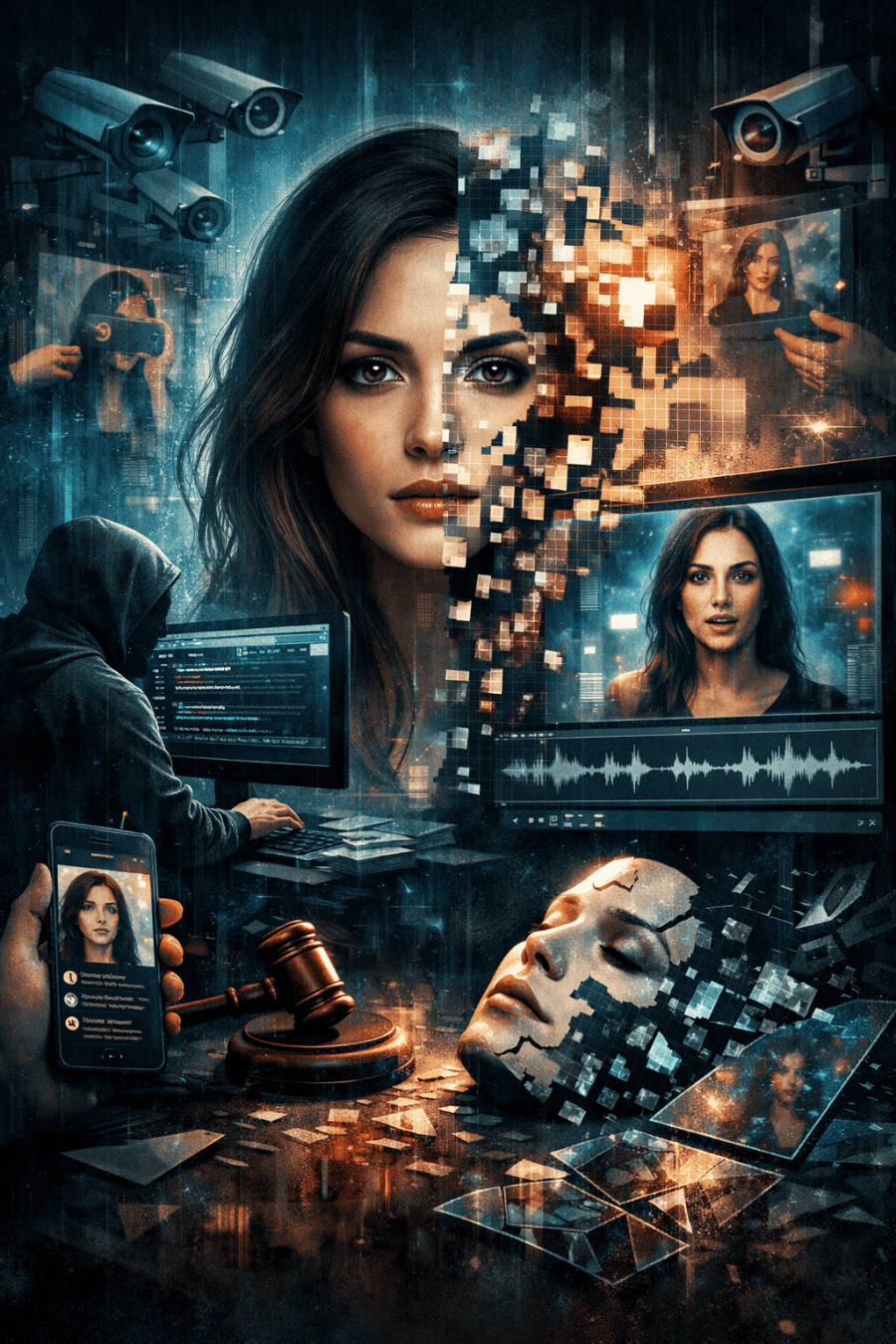
Your face is no longer entirely yours.
It exists as data — captured in photos, videos, security footage, social media archives. It can be scraped, modeled, animated, reproduced. Someone across the world can generate your likeness without ever meeting you. They can make you speak words you never said. They can place you in scenes you never entered.
In the age of synthetic media, identity becomes portable.
Consent struggles to keep up.
Historically, ownership of the self was anchored to the body. Harm required proximity. Violation required contact. Digital replication dissolves that boundary. A person can be copied without being touched, yet still experience the psychological aftermath of being misrepresented, exploited, or distorted.
The law treats likeness as intellectual property.
The mind experiences it as invasion.
We are beginning to see a new category of harm: not physical injury, not theft of property, but theft of presence.
In online gaming spaces, a popular streamer uses software that captures an opponent’s voice mid-match and repurposes it in real time. For the rest of the game, the opponent hears their own voice thrown back at them — exaggerated, looped, weaponized for humor. The audience laughs. The technology is impressive. Yet the joke works by temporarily stripping someone of authorship over their own speech. Their voice becomes a prop detached from intention.
It is a small example. It is also a preview.
In schools, students have begun using synthetic media to fabricate moments that never occurred: a classmate placed into a humiliating video, a teacher made to appear as if they said something inappropriate, a private joke escalated into a permanent digital artifact. Even when proven false, the social damage lingers. Adolescence already magnifies reputation; synthetic media turns rumor into something that looks like evidence. A lie no longer needs witnesses. It only needs a convincing render.
In workplaces, the stakes shift from embarrassment to livelihood. An employee can be inserted into a falsified clip that suggests misconduct. A manager’s voice can be cloned to send fraudulent instructions. A professional reputation — built over years — can be destabilized by seconds of artificial footage. HR departments and legal systems are not designed for a world where proof itself is unstable. Careers begin to hinge not just on behavior, but on the ability to defend against digital impersonation.
In politics, edited clips circulate that place public figures into fabricated moments: a gesture that never happened, a phrase never spoken, a confession stitched from fragments. Even when the edits are later debunked, the emotional imprint remains. People do not remember corrections as strongly as they remember spectacle. Synthetic media exploits that asymmetry. The damage does not require permanence. It only requires virality.
When anyone can wear your face or voice, identity stops being singular. It becomes a template others can borrow.
And the deeper the technology goes, the harder it becomes to separate authenticity from fabrication.
Trust erodes quietly.
If seeing is no longer believing, every image becomes suspect. Every recording becomes negotiable. Reality itself starts to feel editable. The social contract — built on shared perception — weakens. We begin to live in a culture where evidence competes with aesthetic plausibility.
The existential question is sharper than the legal one:
If a version of you can exist without your permission, what part of you remains untouchable?
We like to imagine the self as stable, anchored in memory and intention. Synthetic media reveals how much of identity depends on external recognition. We exist partly in how others perceive us. When perception can be manufactured, the borders of the self blur. Reputation becomes programmable. Presence becomes detachable from personhood.
Consent becomes more than a checkbox.
It becomes an attempt to reassert boundaries in an environment that dissolves them by default.
And the deeper fear is not simply misuse. It is normalization. The moment society decides that partial copies of people are acceptable collateral for entertainment, persuasion, or profit, we redefine what it means to be a person in public space. We quietly agree that fragments of the self are fair game.
Personhood becomes divisible.
Consent, then, is no longer just about permission. It is about preserving the idea that a human being is not raw material. Not a dataset. Not a costume others can wear. But a boundary that matters.
Imagine discovering a video of yourself online.
You are speaking clearly. Your face is lit by a familiar room. Your voice carries your cadence, your pauses, your private humor. The person on screen looks relaxed, confident — and is saying something you would never say. Something cruel. Something career-ending. Something that makes strangers argue about whether you were always this kind of person.
You know it is fake.
But knowledge is private. The video is public.
Friends send messages asking for an explanation. Coworkers go quiet. A relative calls, not to accuse, but to ask what happened. You watch your own likeness circulate, debated like evidence in a trial where you are not present. Every denial sounds weaker than the footage. Every defense feels like an excuse. You are forced into the surreal position of arguing against your own face.
This is the new fragility of identity.
Not that we can be copied —
but that the copy can outrun us.
Consent, in this landscape, is no longer about politeness or platform rules. It is about survival. It is about maintaining a boundary between the self that lives and the self that can be manufactured. Without that boundary, personhood becomes negotiable. Authenticity becomes a burden placed on the victim rather than an expectation placed on the world.
The future fear isn’t that machines will imitate us.
It’s that we will spend our lives proving we are ourselves.

