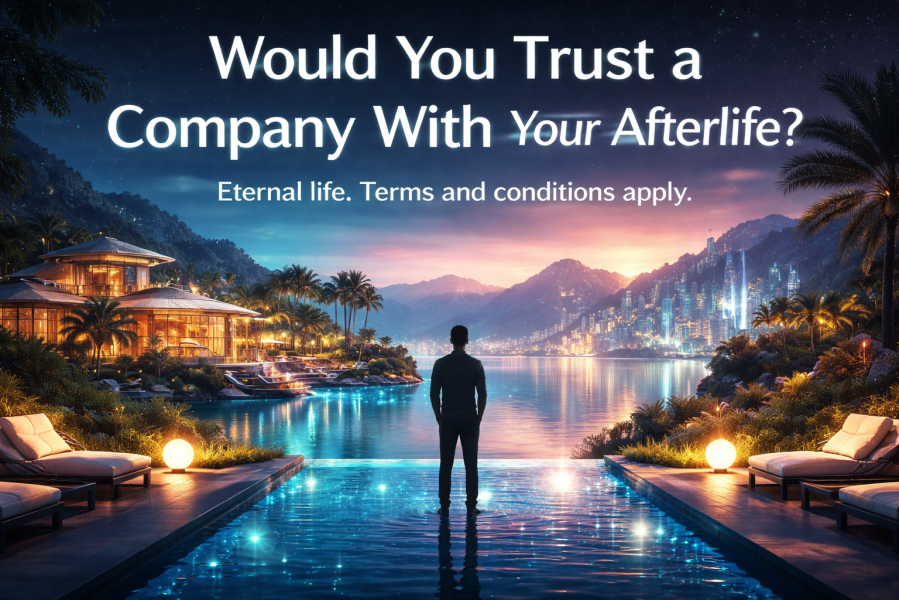
If a company offered you a guaranteed afterlife — a beautiful villa, endless comfort, your favorite food on demand, friends who never age, and the ability to talk to your family whenever you want — would you sign?
That’s the unsettling question hiding underneath the glossy surface of the TV series Upload. The show presents a future where death isn’t the end. Instead, your consciousness can be uploaded into a digital afterlife run by corporations. Heaven isn’t divine. It’s a service plan.
And the longer I watched, the less it felt like science fiction and the more it felt like a warning.
Uploading is seductive for obvious reasons. Humans fear death more than almost anything. We fear disappearing. We fear losing the people we love. We fear the silence of nothingness. A digital afterlife promises relief from all of that. You don’t vanish. You transition. You stay reachable. You remain present.
Grief becomes manageable when someone is still there — still talking, still laughing, still existing in some form.
But Upload asks a question we rarely consider when imagining immortality: what happens when eternity has a billing cycle?
In the show, existence itself is subscription-based. If payments stop, comfort disappears. Your environment shrinks. Your freedoms narrow. Your reality degrades. The afterlife isn’t guaranteed — it’s rented. That idea is more disturbing than any horror movie monster, because it’s not built on fantasy. It’s built on economics.
We already trust corporations with enormous parts of our lives. Our memories live in cloud storage. Our conversations pass through private servers. Our identities are tied to digital platforms. We accept terms and conditions without reading them. We trade privacy for convenience every day without hesitation.
Uploading would feel like a continuation of that pattern, not a radical leap.
And that’s the frightening part.
Trusting a company with your afterlife creates the ultimate power imbalance. You can’t switch providers easily. You can’t walk away. Your consciousness depends on infrastructure you don’t control. Whoever owns the servers owns your reality. Regulation might exist, but enforcement would always lag behind technology. Laws struggle to keep up with social media — imagine trying to regulate eternity.
The show also hints at something even more unsettling: what if uploading changes you? What if living in a limitless digital environment expands your mind in ways your biological brain can’t contain anymore? What if the bridge back to the physical world burns the moment you cross it?
Immortality might not just be permanent. It might be irreversible.
That raises a deeper philosophical question: is a digital copy of you still you? If your thoughts continue, your personality persists, and your relationships survive — does it matter whether your body does? Or is there something essential about being human that can’t survive conversion into data?
Upload doesn’t give easy answers. Instead, it mirrors our present reality in exaggerated form. We already live in a world where comfort is monetized, attention is commodified, and connection is mediated by technology. The show simply extends that logic to its extreme conclusion: capitalism reaching beyond life itself.
Maybe the real horror isn’t the technology. Maybe it’s how familiar it feels.
If a flawless upload system existed tomorrow — safe, stable, luxurious — millions would sign up. Not because they’re foolish. Because they’re human. Love, fear, grief, and hope are stronger motivators than philosophical caution.
And that leaves us with the question the show quietly plants in the viewer’s mind:
If eternity came with terms and conditions… would you read them?
Or would you click “accept” just to stay a little longer?


This really hit for me, because Upload doesn’t feel like a far-off dystopia — it feels like a logical next step. The idea of an afterlife as a service plan is chilling precisely because it mirrors how we already live. We’ve normalized subscriptions for comfort, convenience, even connection. Extending that model to existence itself doesn’t sound outrageous anymore — it sounds familiar.
What unsettles me most is the power imbalance you point out. An afterlife you can’t leave, pause, or fully control isn’t freedom — it’s dependency. Eternity tied to billing cycles turns immortality into leverage, and that’s far scarier than death being final. At least mortality is equal. A corporate heaven wouldn’t be.
The question of identity lingers too. If a version of you continues thinking and loving, is that you — or just an echo optimized for continuity? And if crossing over means you can never return, are you choosing eternal life… or surrendering something essential about being human?
You’re right: the horror isn’t the technology. It’s how easily we can imagine ourselves accepting it. Fear of loss, love for others, the desire to stay — those would outweigh any fine print for most people.
That final question lands hard. Because if eternity showed up wrapped in comfort and familiarity, I’m not sure how many of us would actually stop to read the terms.
LikeLike
I love how you expanded this — especially the line about mortality being equal while a corporate heaven wouldn’t be. That reframes the whole show in one sentence. Conversations like this are why I wanted to write about Upload in the first place. It stops being sci-fi and starts being a mirror. Thank you for adding to it.
LikeLike