
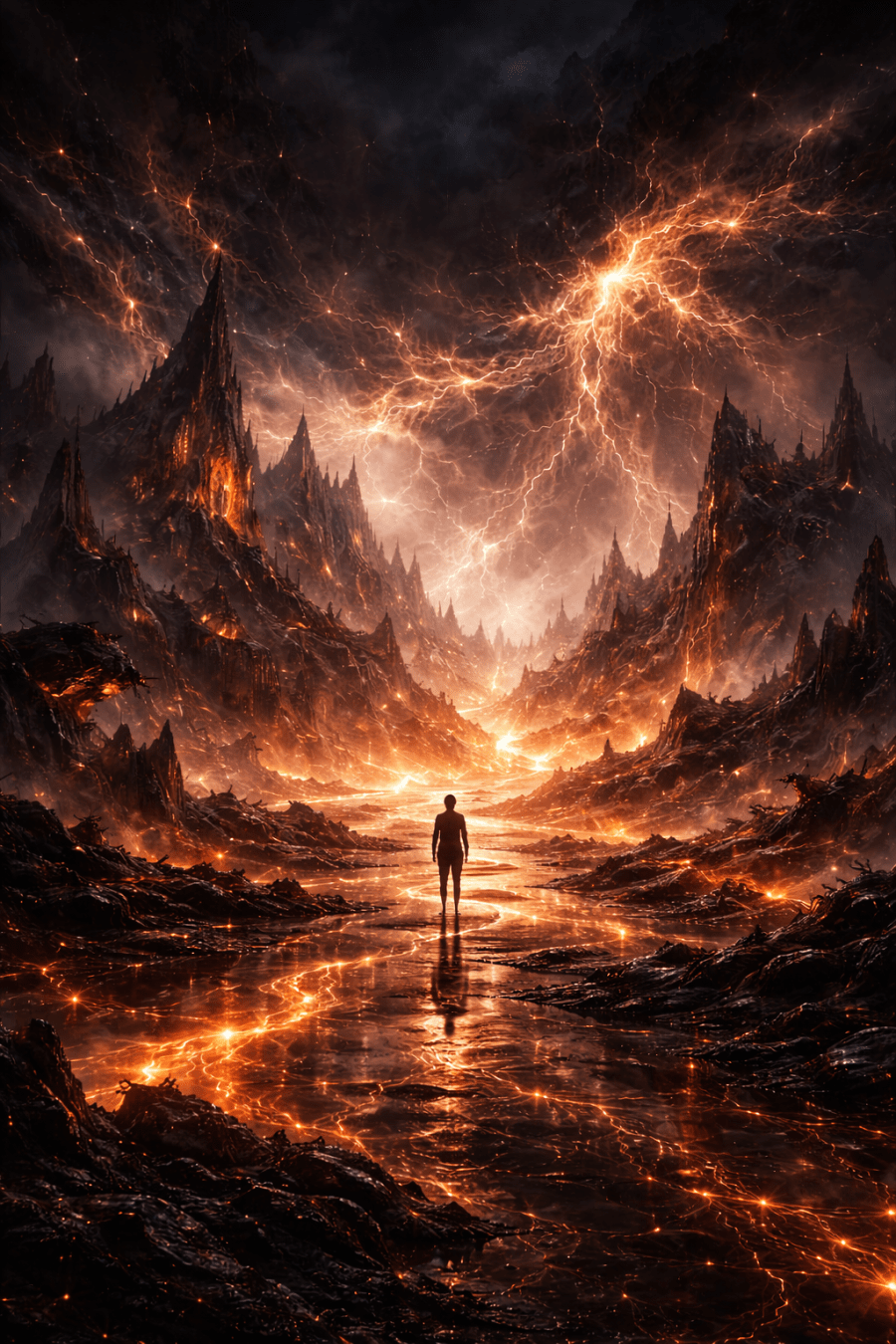
Where calm bends, fury rises; where creation falters, chaos begins its slow, patient shaping.
Anger is not loud. It is not fire that announces itself. It is the tremor beneath the foundation of everything you know, the pulse that sharpens the edges of air and stone. You feel it first in the chest—a tightening, a vibration that does not seek permission. It does not ask for recognition; it simply exists.
The world bends to it. Mountains jagged as teeth erupt from nothing, storms twist without language, rivers boil and shimmer with molten shadow. Creatures born of joy recoil, their glass feathers shivering in heatless wind. Cities tremble, streets curl inward, spires bending under the weight of unspoken rage. Nothing built by patience escapes its touch.
Yet chaos is not random. It is deliberate, a sculptor shaping everything with unflinching precision. Predators stalk silent alleys, their eyes molten suns. Lightning arcs in patterns too sharp for human comprehension. And in the tremor, you understand: anger is a creator too, one that builds through destruction, one that teaches with friction and risk.
You want to turn away. You cannot. To witness it is to feel your own heartbeat accelerate, to realize that your own quiet fury lives here too, mirrored and magnified. Every pulse, every impulse, every forgotten irritation becomes part of the architecture of chaos.
And when you finally leave, the pulse remains. Not outside you, but inside, a weight and a rhythm. You do not feel safe. You do not feel calm. You feel alive.
In the world born of feeling, anger is neither enemy nor friend—it is a force, patient and eternal, shaping everything that dares to exist.


This piece hits like a low-frequency rumble—you don’t hear it so much as feel it settle into your bones. I love how anger is stripped of spectacle here and given gravity instead. It isn’t explosive; it’s architectural. The idea of chaos as a sculptor, deliberate and exacting, feels especially sharp—destruction with intent, not noise.
What resonates most is how inward the ending turns. The world fractures and reforms, but the real reckoning is realizing that this force isn’t foreign at all. It lives in the chest, in the pulse, in the small, unspoken frictions we carry. That recognition makes the final lines powerful: anger not as villain or ally, but as something ancient and shaping, impossible to deny.
It leaves you unsettled in the best way—not soothed, not resolved, just vividly aware. Alive, as you said.
LikeLiked by 2 people
“Architectural” is such a perfect word for what I was trying to reach. I didn’t want anger to feel like an explosion — more like pressure that reshapes the landscape whether we consent to it or not. You caught that gravity exactly.
I’m especially glad the inward turn resonated. For me, the world fracturing was never separate from the personal reckoning; it was a mirror. Anger feels external until the moment you recognize its rhythm inside your own chest, and that recognition is the real disturbance.
Thank you for sitting with the discomfort of it instead of trying to soften it. That unsettled awareness you described is the space this episode lives in.
LikeLiked by 1 person