
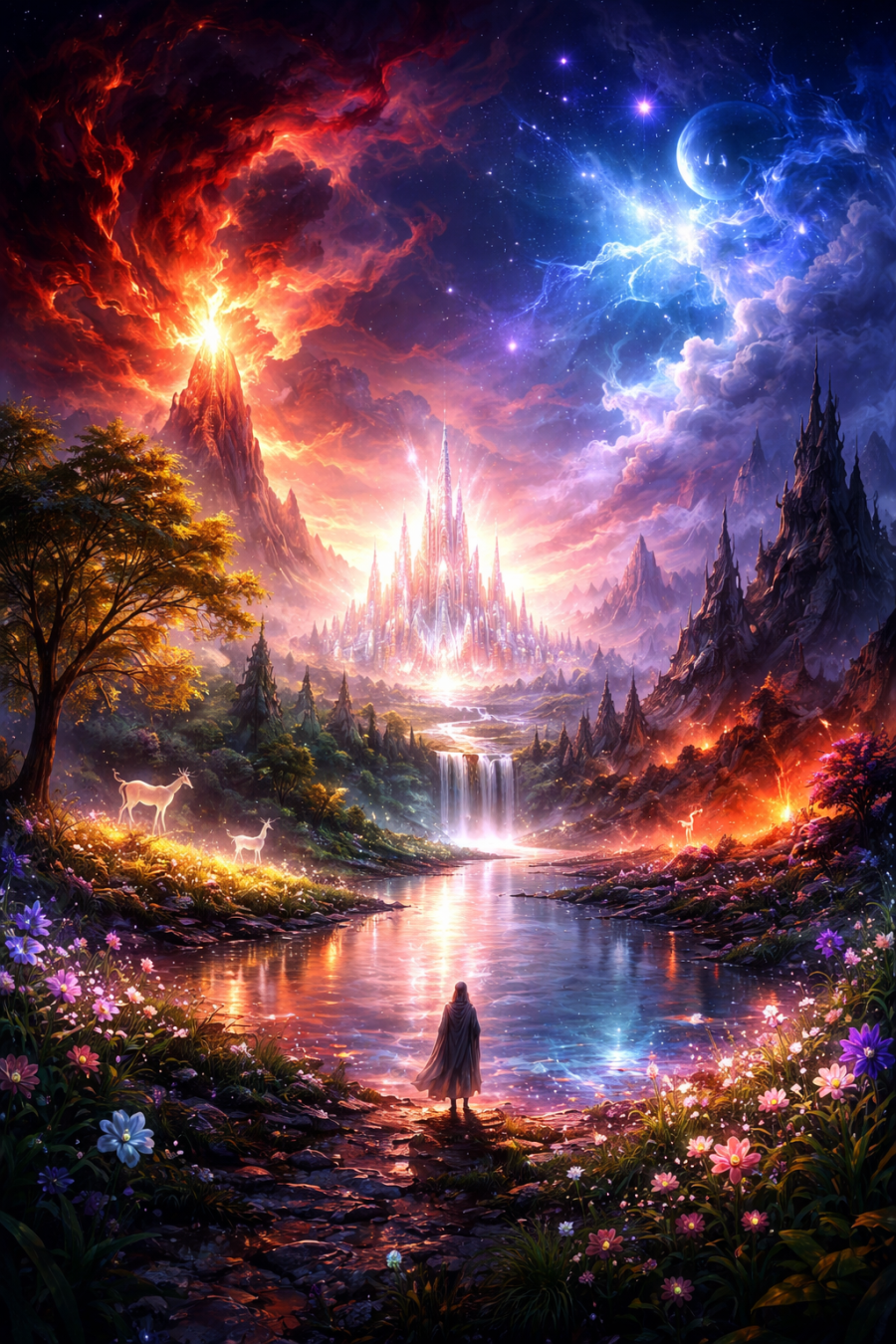
In the beginning, there was nothing. Not a star, not a shadow, not even the concept of distance. The universe stretched endlessly in all directions, a blank canvas of emptiness so absolute it made thought itself shiver. All that existed moved through it like ghosts—formless, aimless, untouched by color, by sound, by light. Time had no meaning here, and yet it passed, measured only by the slow, hollow drift of the void.
Then, impossibly, it began. A tremor, not in the bones of the universe, but in its soul. A spark of feeling—strange, alive, and terrible—flared in the nothingness. First, faint and trembling, like the echo of a heartbeat in a vacuum. Then stronger, a tide of emotion that twisted and shaped the void. Color bled into being—soft golds of dawn, bruised purples of twilight, harsh reds of rage and molten yellows of hope. Sound followed: whispers in the windless nothing, laughter that had never been heard, cries that echoed before they were spoken.
From joy came the first light, warm and radiant, spilling across the void. From sorrow came shadow, pooling and deepening the unseen corners of existence. From love, creatures emerged: fragile birds with feathers of liquid glass, towering beasts with eyes like molten moons, cities of delicate spires and sprawling markets built from kindness itself. Every smile, every tear, every pulse of feeling shaped the world, carved it, gave it form.
And yet, with creation came its twin. Anger, hatred, fear—darkness that gnawed at the edges of this newborn universe. Where joy had built, rage could tear down. From hatred rose jagged mountains, storms that shrieked in no language, predators with teeth that shimmered in shadows. No sooner had love given life than destruction answered, and the balance was immediate, inevitable.
Societies formed around this strange duality. Factions arose, committees and departments, scholars and philosophers, all attempting to study, to understand, to control what had no master. Laws were written for feelings. Prisons were built for souls. Experiments conducted in light and in shadow. And yet, for every law, every restraint, emotion found a way to slip free. Hatred burned even in the hearts of the kindest. Love flickered in the cruel. No one could be contained, not really—not the anger, not the joy, not the sorrow, not the terror, not the hope.
It became clear that the universe itself was alive, and that its life was not neat or polite. To contain emotion was to suffocate it, to twist it into something unrecognizable, to make it deadly. Yet to let it run free was chaos: beautiful, frightening, necessary chaos. Those who tried to control it discovered the truth: emotions cannot be silenced, cannot be locked away. And the universe, born from feeling, would not allow it.
In the end, the question was not how to control a world built from emotion, but how to survive it without lying to ourselves. How do you live in a reality where love can save as easily as hatred can erase, where joy can illuminate but sorrow can consume, where every heart is both sanctuary and battlefield? To deny feeling is to hollow the world into something lifeless; to weaponize it is to turn existence into endless war. Perhaps the only honest choice is neither control nor surrender, but witnessing—to feel fully, to speak carefully, and to accept the weight of what we create simply by being alive.
For in a universe born of emotion, every feeling is an act of creation, every silence an act of destruction—and to exist is to be responsible for both.

