
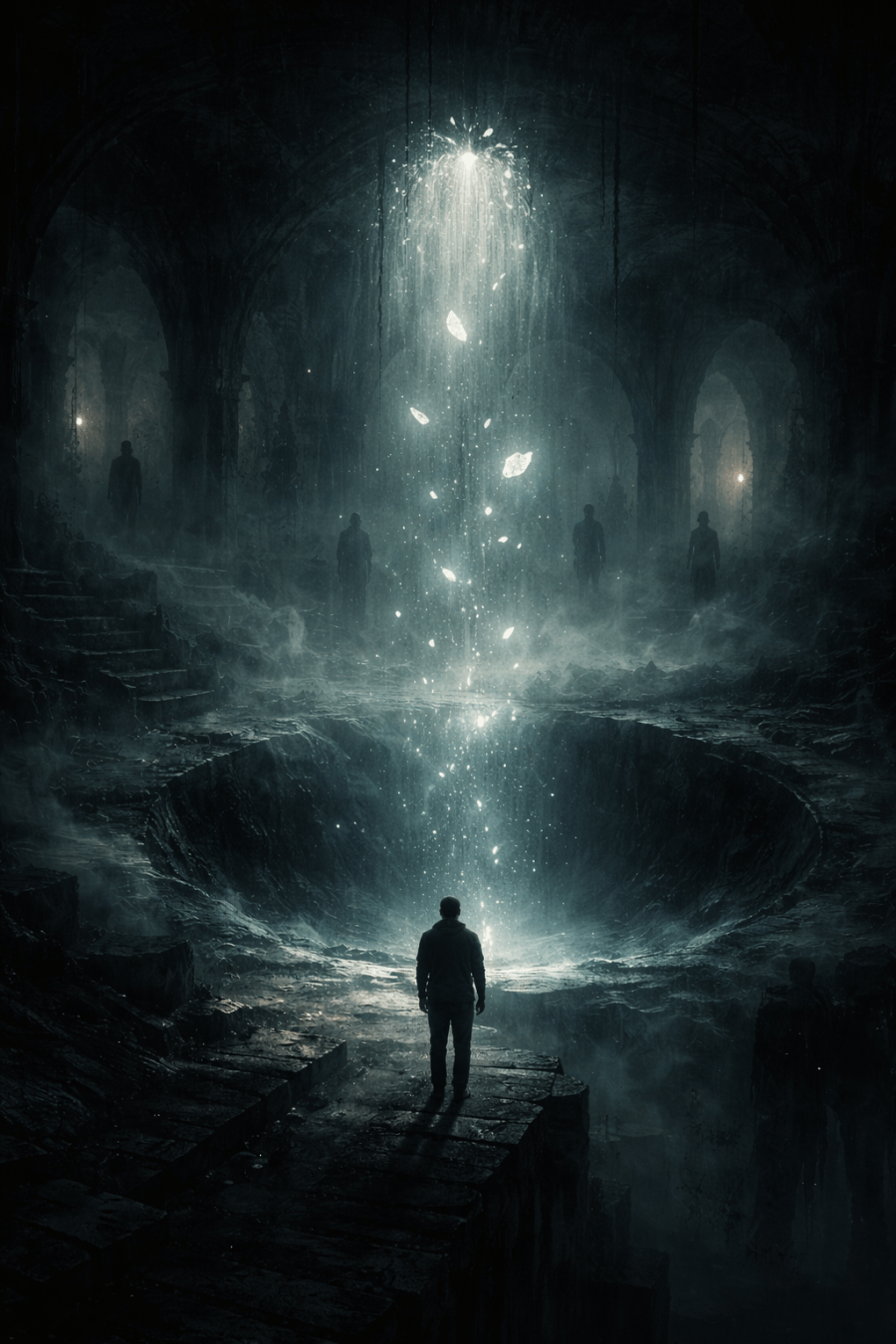
The Place That Feeds on Memory
The place does not exist in any way that can be mapped.
During the day, it collapses into nonbeing—a thinning of reality so subtle the mind refuses to acknowledge it. A blind spot in the world. A stretch of space where intention falters. People walk past it carrying full lives and never realize they have brushed against the edge of something immense.
But at certain hours of the night, the world loosens.
It happens when sleep presses close but does not arrive. When streets grow hollow and the air feels heavier than it should. When the city’s noise recedes into a distant echo, as though sound itself has learned to be careful.
That is when the place opens.
There is no doorway. No moment of crossing. You simply become aware that something around you has emptied itself. Light grows uncertain, flattening into pale, exhausted hues. Shadows lose their allegiance to form. Distance begins to behave like a suggestion rather than a rule.
You are not pulled inside.
You are allowed in.
The place resembles nothing familiar for long. Structures attempt to form—corridors, chambers, open expanses—but they dissolve when examined too closely. The ground does not feel solid, yet it supports you. The walls do not confine, yet you remain contained. Above, there is no sky—only a vast, depthless dark that absorbs attention without reflecting it.
This is not space.
This is a void that learned to endure.
The longer you remain, the more you feel an internal pressure—not pain, not fear, but a gentle insistence. Thoughts rise unbidden. Memories loosen. A smell from childhood. The weight of a hand once held. A moment you thought insignificant, now unfolding in full detail before drifting away from you.
The sensation is unsettling because it is not cruel.
The place does not tear memory from you. It receives it.
Each surrendered remembrance drifts downward, dissolving into the dark where it feeds the source at the void’s center—a gravitational absence that sustains the place’s fragile existence. Memory is its currency. Without it, the void would starve, collapse, and return to nothing.
And within the darkness, something else stirs.
The inhabitants linger at the margins, barely distinguishable from the dark itself. They are not whole beings. They are residues—shapes formed from what remains after memory is consumed. They move without steps, gather without intention, drawn toward the warmth of what you still carry.
These are the lost.
Some were visitors who gave too much. Others arrived already broken, already hollowed by grief, longing, or obsession. What remains of them is quiet and incomplete. They do not speak, but sometimes a feeling brushes against you—recognition without context, sorrow without origin, love stripped of a name.
They are sustained by what the void remembers for them.
Time has no meaning here. Minutes stretch into something immeasurable. Hours compress into a single breath. When the flow of memory slows, the place begins to weaken. The dark thins. The pressure lifts. Shapes unravel like thoughts upon waking.
You are released.
You step back into the ordinary night unchanged to any outside eye. You walk. You breathe. You answer when spoken to. But somewhere inside you, a quiet absence has formed. A memory you cannot summon. A person you know mattered, though you can no longer say why. A moment that once defined you, now gone without leaving a scar.
The place keeps what you forget.
And on other nights, when the world grows thin again, it will open once more—patient, vast, and gently starving. A void that does not destroy, only gathers what cannot be held forever.
Because memory is not eternal.
And nothing that feeds on it ever truly sleeps.

