
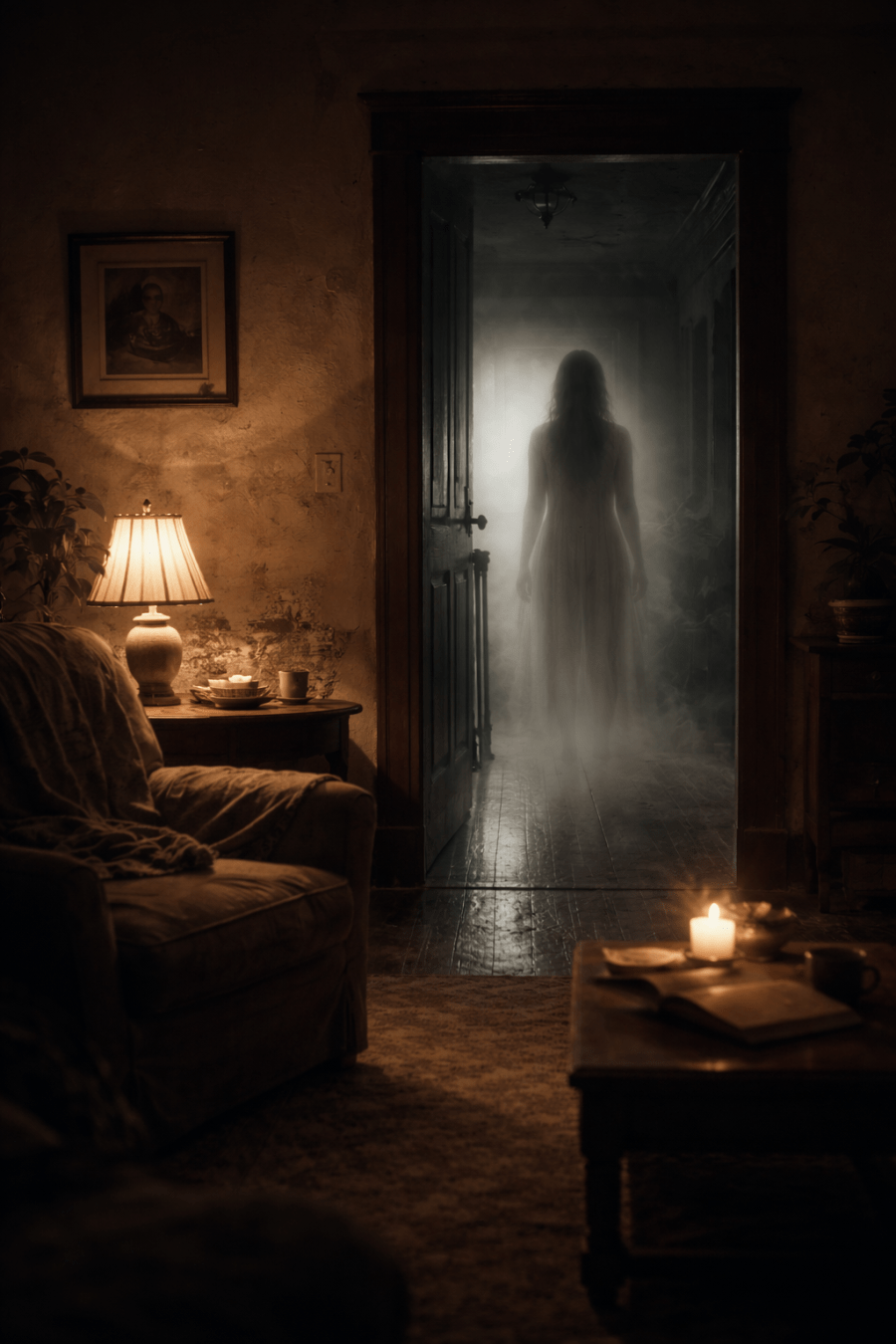
Something Has Been Living in Your House for Years, and It Doesn’t Want to Leave
You don’t remember the first time it arrived.
There was no announcement. No creak that belonged to nothing. No shadow that moved differently from the light. Just small absences—air that felt thicker in the corners, warmth that lingered in rooms long after the sun had left, sounds that were there and then weren’t.
At first, you convinced yourself it was the house. Old houses breathe. They settle. They remember. You walked past walls and floors and thought you understood the rhythm of the place. But something inside you knew better. Something too patient to make itself known all at once.
Across cultures, there are explanations—beliefs shaped by centuries of watching what we cannot see. Some say spirits linger because they died in a place they cannot leave, tethered to land, to walls, to memory. They are not cruel. They are not kind. They simply exist in the space between now and what was, moving through years without need for recognition. They do not demand attention. They only persist.
Others say they stay for a purpose. That this presence watches over you. Guardian, ancestor, protector. You notice it in the smallest mercies: a danger avoided at the last second, a shadow that falls over a broken window before the glass hits, a feeling that someone—or something—is there, quietly saying not this one. It is not visible. It is not audible. But it is there. Always. Waiting, patient, deliberate.
And then there are the darker stories. Those whispered in hushed corners, never written in polite books. Spirits that attach themselves—not to houses, but to people. You may have crossed its path, unwittingly disturbed it, allowed it near without knowing. It does not protect. It does not forgive. It claims. And it waits. Always.
You feel it in the hush of the night. In the heavy air of rooms you haven’t entered for months. In the inexplicable weight against your chest when you lie down to sleep. A name forms on the edge of your lips—yours, or perhaps its own—but it never reaches sound. You hear nothing, yet the silence itself presses in on you, thick and cold.
Time passes. You grow older. Walls are repainted. Furniture replaced. People come and go. But the presence stays, unchanged, as if the world itself bends around it, accommodating it. It knows the cadence of your days, the quiet rhythm of your breathing, the uneven pace of your heart. It is patient, patient beyond comprehension, because centuries—decades—mean nothing to it.
Perhaps it cannot leave. Perhaps it refuses. Perhaps it waits because you have never acknowledged it, never asked it to go. Perhaps, in some quiet way, it has grown fond of your existence, or perhaps it has learned that it has power over you only because you allow it to inhabit the same walls, the same air, the same fleeting moments.
Some traditions say respect is survival. Others say distance is the only safety. Some insist that acknowledging its presence grants it power. Others that ignoring it is the insult that turns it cruel. None of them can tell you the whole truth, because the truth is not shared. It is observed, quietly, by those who live too long, too deeply in a world most cannot see.
And still, it remains.
Years pass. You are older now, and the weight of its watching sits differently in your chest. You are no longer surprised by the cold corners, the inexplicable warmth, the moments when a shadow falls just right. You sense it as you sense your own heartbeat: subtle, essential, unavoidable.
And in the stillness, you realize something terrible and beautiful: you do not live alone. You have never truly lived alone.
Whatever has shared your walls, your air, your years—it does not see the house as yours.
It sees it as home.
And perhaps, deep down, part of you always has too.
 The Cozy Nook | Stories · Food ·Gaming·Magic