
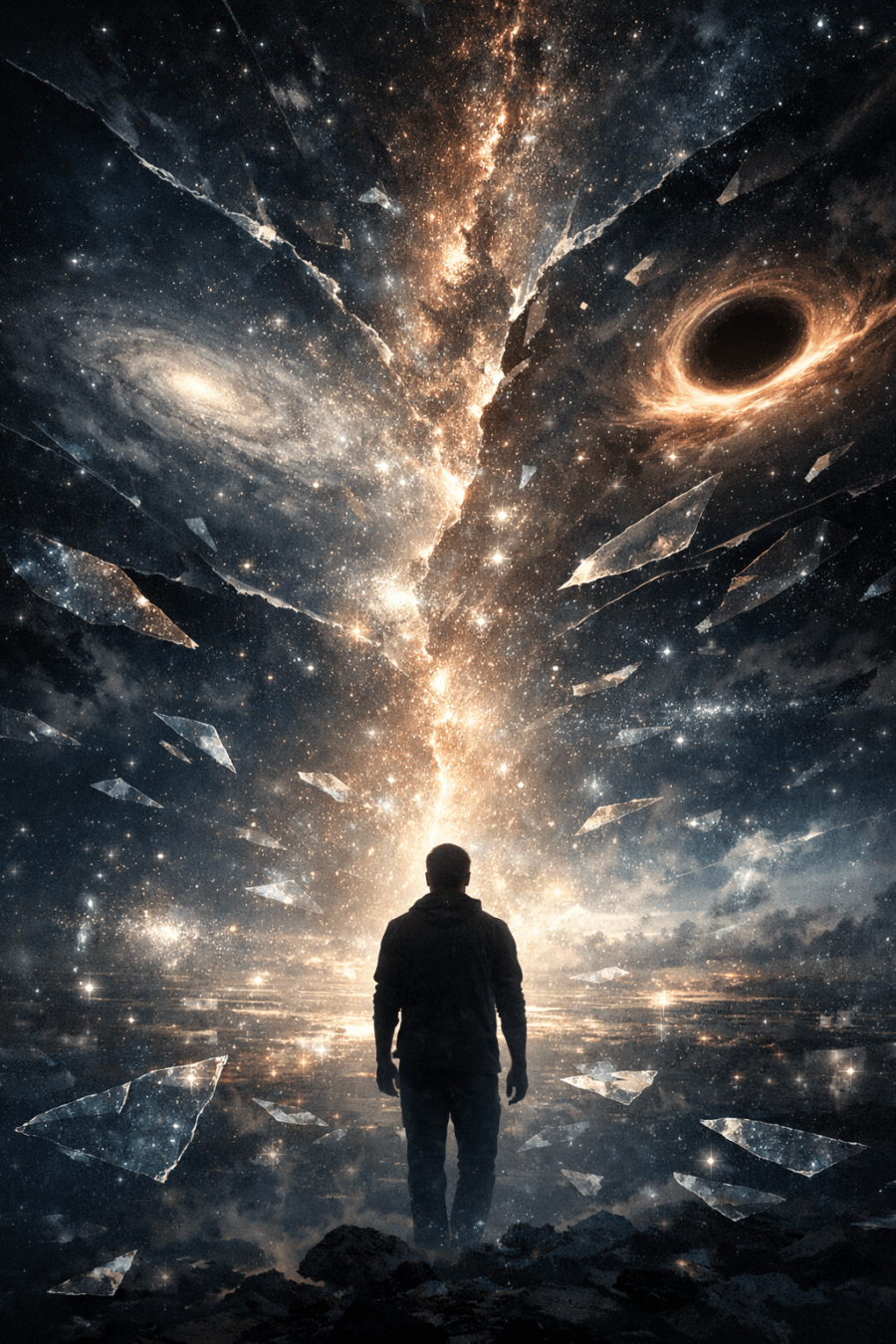
What if the Universe Isn’t Expanding—but Remembering?
I don’t understand the universe the way scientists do.
I know fragments. Names. The shapes of ideas without their full weight.
Black holes. Time dilation. The Big Bang. Expansion. Collapse.
Words we use like anchors, even though they barely touch the bottom.
Most days, we speak about the universe with confidence—charts, equations, clean explanations. We say it began here. We say it’s moving there. We say time flows forward, that space stretches, that everything is racing away from everything else.
But when you strip it down, so much of this is belief layered over distance.
We never see the universe as it is.
Only as it was—light delayed by millions, sometimes billions, of years.
We stand in the present, guided by ancient photons, trusting that what they show us still exists.
That feels less like observation and more like memory.
The stars we admire tonight may already be gone. Their light survives them, crossing the dark long after their bodies have collapsed. We call that beauty. We call it wonder. But there’s something unsettling in realizing how much of the universe is made of afterimages.
Ghosts of light.
We tell ourselves the universe is expanding. That space itself is stretching, pulling everything farther apart. But what if that stretching isn’t growth?
What if it’s recollection?
Memory doesn’t stay still. It distorts. It spreads unevenly. It thins at the edges. The farther you move from its source, the harder it is to tell what truly happened from what’s been reshaped by time.
The universe behaves the same way.
Black holes are said to erase everything—matter, light, even time. And yet, some believe nothing is truly lost. That information can’t be destroyed, only hidden beyond a boundary we can’t cross. Preserved in silence. Stored where cause and effect no longer make sense.
That doesn’t sound like annihilation.
It sounds like forgetting so deep it feels permanent.
Or remembering in a language we don’t understand.
We call the beginning the Big Bang, as if naming it makes it manageable. As if calling it an explosion explains why existence happened at all. Others say the universe was created by intention—by something aware, something higher.
Both ideas feel unfinished.
Both feel like hands reaching into the dark and stopping just short of truth.
Maybe the universe doesn’t move forward the way we think it does. Maybe time isn’t a straight line, but a loop that keeps brushing against itself. Maybe what we call progress is just repetition at a different scale.
We look outward, convinced the answers are farther away—older stars, deeper space, more distance. But what if distance isn’t revealing the future?
What if it’s revealing the past, over and over again?
What if the universe is not expanding into something new—but slowly replaying what it has already been?
We exist inside a structure that bends time instead of obeying it.
That preserves light long after its source is gone.
That lets echoes outlive their origins.
And we call this behavior normal.
I don’t know what came before the beginning.
I don’t know what waits inside a black hole.
I don’t know whether the universe was born from chance or intention, accident or design.
What I know is how it feels to look up and realize how small our certainty is.
To sense that what we call reality might be a surface layer—thin, fragile, incomplete.
To wonder whether the universe is less like a machine and more like a mind.
Not expanding—
but remembering itself in pieces.
And maybe we aren’t explorers moving forward through space at all.
Maybe we are fragments inside a vast memory,
learning how to exist while the universe quietly tries to remember what it once was.


This reads like a gentle reconciliation with not knowing—and there’s something profoundly hopeful in that. Seeing the universe as memory doesn’t diminish it; it makes it tender. Light becomes a gift carried forward, not a delay. Existence becomes continuity instead of loss. If the universe remembers itself through stars, echoes, and us, then being here matters in a quiet, sacred way. We aren’t late to the truth or cut off from it—we’re part of how it endures. And in a cosmos built from remembrance, wonder isn’t uncertainty’s shadow; it’s proof that meaning survives distance, time, and even disappearance.
LikeLiked by 1 person