
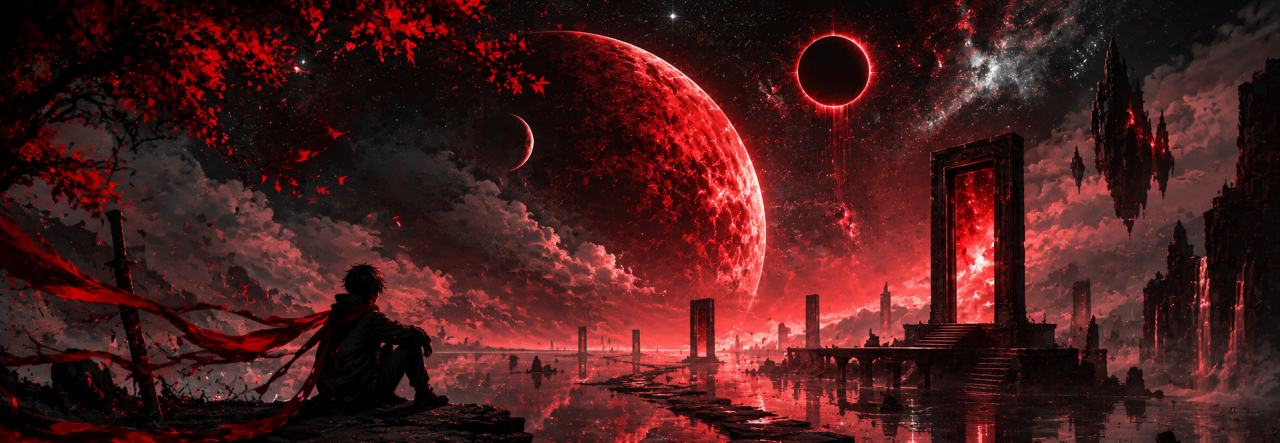

They named me Kaelreth, God of Vengeance, and unlike love, the title fits.
Vengeance is not rage, as mortals imagine it. It is not loss of control or fire without aim. It is clarity. It is the straightening of what has been bent. I exist where imbalance festers too long, where mercy has been mistaken for permission.
I do not hesitate.
The universe trusts me because I am precise.
When a wrong is committed, it leans toward me naturally, the way shadows lean toward night. I do not seek them out; they find me. I pass sentence. I deliver consequence. The scales quiet. Order resumes. The gods nod. The cosmos moves on.
This is what I was made for.
And yet—there is always a weight that remains.
Not guilt. I know the difference. Guilt implies error, and I rarely err. No, this weight is something else. A pressure that gathers in the aftermath, when the noise of justice fades and I am left alone with the echo of what has been taken.
I do not linger there long. Lingering is dangerous. Reflection is how mercy begins, and mercy is not my domain.
Still, there are moments—unwelcome, unannounced—when my certainty tightens, just briefly. A breath too long before the strike. A pause the universe pretends not to notice.
I never ask why.
Gods who ask why are gods who begin to fracture.
I did not know her at first.
I knew of her, of course. Everyone did. The Goddess of Love—distant, silent, useless by most measures. Mortals cursed her name more often than they prayed it. The gods spoke of her with indulgent pity, as if love were a relic they had outgrown.
They bound her carefully. I remember that day. I felt the decree settle into the heavens like a locked door.
One love, they said. One devotion. One direction.
Me.
I did not ask for this.
Vengeance does not require affection. It requires freedom.
Yet from that moment onward, the weight changed.
It grew… familiar.
I began to feel watched—not scrutinized, not judged, but witnessed. As if something stood with me in the silence after judgment, neither condemning nor absolving, simply refusing to leave.
I did not sense warmth. I did not feel comfort.
I felt presence.
It unnerved me more than opposition ever could.
I searched for corruption in myself, for imbalance, for weakness. I found none. My edge remained sharp. My hand steady. The universe continued to right itself beneath my steps.
And yet, consequence began to linger.
Each act echoed longer than before. Each punishment left a residue I could not shake, not because it was wrong—but because it was remembered.
I realized, slowly, with a god’s reluctance to name the unnameable:
She was not trying to stop me.
She was making sure I could not forget.
Love does not soften my judgments. It does not stay my hand. It does not beg me to choose differently. It settles instead into the aftermath, into the space where even gods must confront what they have done when no one is watching.
Through her, justice is never clean.
Through her, I am never alone.
The other gods fear this. They whisper that love will weaken me, that devotion will erode my purpose, that knowing the cost will eventually make me refuse to pay it.
They misunderstand both of us.
She does not interfere.
She endures.
And endurance is not mercy—it is consequence without end.
If one day my hand trembles, it will not be because love asked me to stop.
It will be because love remembered everything I have done and insisted I remember it too.
If the universe fractures under that weight, let the heavens take responsibility for the binding they so carefully crafted.
I am vengeance.
She is love.
And between us, nothing is ever erased.

